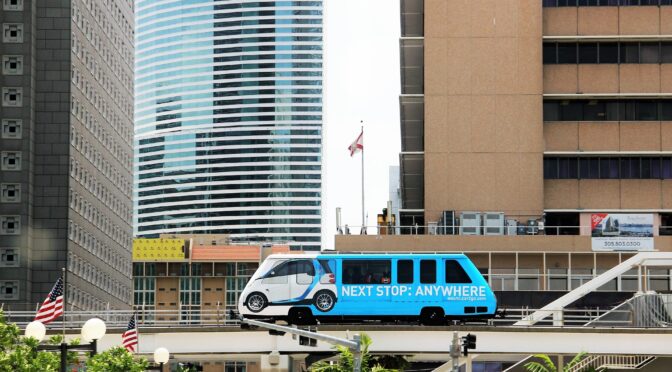
Miami is a driving city, but you can cover a surprising amount of it without a car. Miami public transportation is built around four pieces: Metrorail, the free Metromover, Metrobus, and free city trolleys. Add two regional trains and you can reach the airport, downtown, the beach and the neighboring counties.
This guide explains what each one does, what it costs, and when it makes sense to rent a car anyway. Fares and hours were checked against Miami-Dade County sources in October 2026.
Fares at a glance
| Service | Fare |
|---|---|
| Metrorail | $2.25 per trip |
| Metrobus | $2.25 per trip |
| Metromover | Free |
| City trolleys | Free |
| 1-Day Pass | $5.65 |
| 7-Day Pass | $29.25 |
| 1-Month Pass | $112.50 |
The easiest way to pay
You do not need a transit card. Tap a contactless Visa, Mastercard or American Express card, or a phone or watch with Apple Pay, Google Pay, Samsung Pay or Fitbit Pay, at the Metrorail gate or bus farebox.
Tapping also gets you fare capping. Once you have paid $5.65 in a day, the rest of your Metrorail and Metrobus rides that day are free. That is the price of a day pass, without having to buy one.
Three rules to keep the cap working:
- Use the same card or device all day. A phone and a watch linked to the same card count as two different riders.
- Each rider needs their own card or device.
- Some cards issued outside the United States may not be accepted. Have a backup.
If you prefer a transit card, an EASY Card costs $2 and can be loaded with cash value or passes at station vending machines. Transfers between bus and rail are free with an EASY Card or EASY Ticket. Riders paying cash on the bus pay the full fare each time they board.
Full details are on the county’s transit fares page.
Metrorail
Metrorail is the elevated train. It runs from 5 a.m. to midnight, seven days a week, on two lines that share most of their track:
- Green Line. From Palmetto in the northwest, through downtown, to Dadeland South.
- Orange Line. From Miami International Airport, through downtown, to Dadeland South.
Useful stops for visitors include Government Center (downtown), Brickell, Vizcaya, Coconut Grove, and University (for the University of Miami).
Weekend change. On Saturdays and Sundays the Orange Line runs only as a shuttle between the airport and Earlington Heights, every 15 minutes. Change there for a Green Line train to downtown.
Parking at Metrorail stations costs $4.50 a day, which makes park-and-ride into downtown far cheaper than a downtown garage. Bikes are allowed on trains.
See the county’s Metrorail page for maps and schedules.
Metromover
The Metromover is a free, driverless train that loops through downtown and Brickell. It is the most useful piece of the system for visitors, and it costs nothing.
- 21 stations on three loops: Inner (downtown), Omni (north to the Arsht Center area) and Brickell (south).
- Hours: 5:30 a.m. to 10 p.m., seven days a week.
- Frequency: every 90 seconds at rush hour and every three minutes the rest of the day.
It reaches Bayside Marketplace, the Kaseya Center, Miami Dade College and Brickell City Centre, and it connects with Metrorail at Government Center and Brickell.
The county is upgrading the system, which sometimes means weekend closures on one loop. Check the Metromover page for notices.
Metrobus
Metrobus fills in everywhere the trains do not go, including Miami Beach, which has no rail service.
The route most visitors need is the Miami Beach Airport Express (Route 150). It runs every 30 minutes from 6 a.m. to 11:40 p.m., seven days a week, between the airport’s Metrorail station and Miami Beach, from 41st Street down to South Pointe Drive. The fare is the standard $2.25.
In South Dade, the Metro Express bus rapid transit line now runs between Homestead and the Dadeland South Metrorail station.
Use the county’s trip planner or the GO Miami-Dade Transit app for routes and real-time arrivals.
Free trolleys
The City of Miami and the City of Miami Beach each run free trolleys that work as neighborhood circulators. Miami’s routes reach Little Havana, Wynwood, Coconut Grove and the bayfront. Miami Beach’s four routes run the length of the island from 8 a.m. to 11 p.m. daily.
They are separate systems with separate schedules. Our guide to the free trolleys in Miami and Miami Beach covers every route.
Regional trains: Tri-Rail and Brightline
- Tri-Rail is the commuter train linking Miami-Dade, Broward and Palm Beach counties. It stops at the Miami airport station and at Fort Lauderdale’s airport station, and connecting trains run into MiamiCentral station downtown. Weekday fares are based on distance. Weekends and holidays are a flat $5 for the day.
- Brightline is the faster, pricier intercity train from MiamiCentral to Aventura, Fort Lauderdale, Boca Raton, West Palm Beach and Orlando.
Metrorail connects with both: Brightline at the Historic Overtown/Lyric Theatre station, and Tri-Rail at the Tri-Rail station on the Green Line and at the airport.
Getting from Miami airport without a car
Everything starts with the MIA Mover, a free train from the terminal to the Miami Intermodal Center. Find it on the third level, between the Dolphin and Flamingo garages.
| Going to | How | Cost |
|---|---|---|
| Downtown or Brickell | Metrorail Orange Line to Government Center or Brickell | $2.25 |
| Miami Beach | Route 150 Miami Beach Airport Express | $2.25 |
| Coconut Grove | Orange Line to Coconut Grove station, then the free trolley | $2.25 |
| Fort Lauderdale or Palm Beach | Tri-Rail from the airport station | Varies by distance |
| PortMiami | Orange Line, Metromover, then the free Coral Way trolley | $2.25 |
Cruise passengers should read our guide to getting to PortMiami from the airports first, since that trip has a few catches.
When transit works, and when to rent a car
Transit works well for:
- Downtown, Brickell and the bayfront, where the Metromover is free and frequent.
- South Beach, once you are there. The trolley and your feet cover it.
- Coconut Grove, Coral Gables and South Miami along the Metrorail line.
- Airport trips to downtown or the beach.
A car is the better choice for:
- The Everglades, the Keys and most beaches outside Miami Beach.
- Trips late at night, after the Metromover and trolleys stop.
- Families with a lot of luggage, or anyone on a tight schedule.
- The western and southern suburbs, where service is thin.
Many visitors do both: transit for the days downtown and on the beach, and a rental for a day or two of exploring. If you rent, our guides to the MIA Rental Car Center, rental car tolls and Miami Beach parking will save you money.
Frequently asked questions
How much does public transportation cost in Miami?
Metrorail and Metrobus are $2.25 a ride, capped at $5.65 a day when you tap the same contactless card. The Metromover and the city trolleys are free.
Is the Metromover free?
Yes. The Metromover is free for everyone, every day, with no ticket needed.
Can I pay for Miami transit with my phone?
Yes. Metrorail gates and Metrobus fareboxes accept Apple Pay, Google Pay, Samsung Pay and Fitbit Pay, as well as contactless Visa, Mastercard and American Express cards.
Does Metrorail go to Miami Beach?
No. Take Metrobus, such as Route 150 from the airport, or a rideshare. Once on the beach, the trolley is free.
Does Metrorail go to the airport?
Yes. The Orange Line ends at the Miami International Airport station, a short free MIA Mover ride from the terminals.
Is public transportation in Miami accessible?
Trains, buses and trolleys are wheelchair accessible. The county also runs Special Transportation Service, a door-to-door paratransit service for eligible riders, at $3.50 a trip.
The bottom line
For a visit centered on downtown, Brickell and the beach, Miami public transportation is cheap and good enough to skip the rental car, especially with the free Metromover and trolleys. For anything farther out, plan on a car for at least part of the trip.
Fares and schedules were checked against Miami-Dade County, City of Miami and City of Miami Beach sources in October 2026. They change, so confirm before you travel.


