Category Archives: Florida Travel

How to Get to PortMiami from Miami Airport and Fort Lauderdale Airport

PortMiami sits on an island next to downtown Miami, about 9 miles from Miami International Airport (MIA) and about 27 miles from Fort Lauderdale-Hollywood International Airport (FLL). Which airport you fly into changes the trip a lot, so this guide covers both.

Prices are typical figures from official and operator sources, checked in October 2026. The rideshare averages come from Uber’s published route data, last updated in December 2024, so treat them as a starting point. Rideshare and shuttle prices move with demand, especially on weekend cruise mornings.

Quick comparison

FromOptionTypical costTypical time
MIARideshare (Uber or Lyft)About $28 per carAbout 25 minutes
MIATaxiAbout $36 and up on the meterAbout 25 minutes
MIAMetrorail plus free trolley$2.25 per person45 minutes or more
MIACruise line transferSet by the cruise lineVaries
FLLRideshare (Uber or Lyft)About $50 per carAbout 55 minutes
FLLShared shuttleAbout $30 to $35 per person1 to 1.5 hours
FLLBrightline train plus rideshareTrain fare plus two short ridesAbout 1.5 hours
FLLTri-Rail plus MetrorailA few dollars per personAbout 2 hours

From Miami International Airport (MIA)

Rideshare

For most people this is the answer. Uber’s own route data puts the average trip at about $28 and 24 minutes. Pickups are on the arrivals level and the departures level, and the app tells you which door to use.

One car costs the same for one person or four, which makes it cheaper than a per-person shuttle for almost any group.

Taxi

Taxis wait outside baggage claim on the arrivals level. Miami-Dade County eliminated the old flat fares between the airport and the port in 2022, so the trip now runs on the meter:

  • $2.95 for the first sixth of a mile
  • $0.85 for each additional sixth of a mile up to one mile
  • $0.55 for each sixth of a mile after that
  • $0.40 per minute of waiting time
  • A $2 airport fee, and a $15 minimum for trips starting at MIA or the port
  • A 30 percent surcharge for SUVs and vans

Over 9 miles that works out to roughly $36 before any time stuck in traffic. If someone quotes you a “flat rate,” ask for the meter. Rates are posted by Miami-Dade County and on the airport’s taxi page.

Cruise line transfers

Most cruise lines sell a bus transfer from MIA. These are pre-arranged, and pickup is at the airport’s bus stations: the North station at Concourse D, level 1, Door 1, or the South station at Concourse J, level 1, Door 33.

They are priced per person, so they suit solo travelers better than families. The advantage is that the cruise line knows you are on the way.

Public transit for $2.25

It is possible, and it is cheap, but it takes patience and a willingness to walk with your bags.

  1. Take the free MIA Mover from the terminal to the Miami Intermodal Center.
  2. Ride the Metrorail Orange Line ($2.25) to Government Center.
  3. From Government Center, take the free Metromover to Freedom Tower station.
  4. Board the free City of Miami Coral Way trolley, which crosses the bridge onto the port.

Things to know before choosing this:

  • Weekends are slower. On Saturdays and Sundays the Orange Line runs only as a shuttle between the airport and Earlington Heights, where you change to the Green Line.
  • The trolley does not stop at every terminal. Its port stops were relocated in August 2025 because of construction. Depending on your ship, you may have a long walk with luggage.
  • Sunday trolley service starts at 8 a.m. and frequency varies, so this is a poor choice if you are cutting it close.

If you are traveling light and have time, it works. With a family and checked bags, take a car.

From Fort Lauderdale Airport (FLL)

FLL is often cheaper to fly into, but it is three times as far from PortMiami. Do not confuse it with Port Everglades, the Fort Lauderdale cruise port, which is right next to FLL. Check which port your ship sails from.

Rideshare

Uber’s route data puts the average FLL to PortMiami trip at about $51 and 54 minutes over 27 miles. Expect more on weekend mornings and with a larger vehicle.

Pickup points depend on your terminal. For Terminals 1 and 2, the rideshare area is between the two terminals on the arrivals level. For Terminals 3 and 4, it is in the Palm Garage. Follow the signs, since the airport moved these in 2025.

Shared shuttle

Several companies run shared vans from FLL to PortMiami, generally around $30 to $35 per person. For one or two people that can beat a rideshare. For three or more, a private car is usually cheaper and faster. Book ahead and leave a wide margin, since shared vans wait for other passengers.

Brightline train

Brightline is the fast, comfortable option, though it involves three legs:

  1. Airport to station. Brightline’s Fort Lauderdale station is downtown, not at the airport. Brightline runs an Airport Connector Shuttle twice an hour for $12 per person plus a $3 fuel surcharge with a same-day train ticket.
  2. Train. Fort Lauderdale to MiamiCentral takes about 38 minutes. Fares vary by train and how early you book.
  3. Station to port. MiamiCentral is about a 10-minute rideshare from the cruise terminals.

It makes the most sense if you are staying overnight in downtown Miami before sailing. Check fares on Brightline’s site.

Tri-Rail

The budget route. A free shuttle bus runs from the FLL terminals to the Fort Lauderdale Airport Tri-Rail station at Dania Beach about every 15 to 20 minutes. From there, Tri-Rail runs south to Miami, where you connect to Metrorail or a Tri-Rail shuttle train into downtown, then take a short ride to the port.

Weekday fares are based on distance and come to a few dollars. On weekends and holidays Tri-Rail charges a flat $5 for the whole day. The local tourism bureau estimates about two hours for the full trip. See Tri-Rail’s site for the schedule and fare calculator.

Driving and parking at PortMiami

If you are driving in, or dropping off a rental car, here is what port parking costs. Rates are per vehicle and come from PortMiami’s parking page.

WhereOvernight rateNotes
County garages C, D, F and G, and Lot E$28 per day$10 for same-day parking with no overnight stay
Garage B (Norwegian)$35 per dayReserve through the cruise line
Garage AA$35 per day$20 for same-day parking; 7-foot clearance
Garage A (Royal Caribbean)Set by the operatorReserve through the cruise line
Lot E, oversized vehicles$25 per day per spaceRVs and trailers; $50 per day for two spaces

Good to know:

  • Each day or part of a day counts. A seven-night cruise spans eight calendar days, which is about $224 at $28 a day.
  • No debit cards. The port accepts cash, major credit cards and traveler’s checks.
  • Garages are staffed from 6 a.m. to 5 p.m. on cruise days.
  • A free shuttle between garages and terminals runs on cruise days only.
  • Disabled permit holders get two hours free under county rules, and some vehicles and plates are exempt from charges. The port’s page has the details.

For a week-long cruise, parking costs far more than a rideshare from either airport. If you rented a car for a few days before sailing, return it and take a ride to the port. Our guide to the MIA Rental Car Center explains the return process.

Frequently asked questions

How far is Miami airport from the cruise port?

About 9 miles. The drive usually takes 20 to 30 minutes, longer in rush hour.

How much is an Uber from Miami airport to the Port of Miami?

Uber’s route data shows an average of about $28. Prices rise at busy times.

Is there a flat taxi rate from MIA to PortMiami?

No. Miami-Dade County eliminated flat taxi fares in 2022. Taxis run on the meter, with a $15 minimum for trips starting at the airport or the port.

Should I fly into Miami or Fort Lauderdale for a PortMiami cruise?

MIA is much closer and the transfer is cheaper. FLL can still come out ahead if the flight savings are larger than the roughly $25 extra each way for the ride, and you have the extra hour.

Is there a free shuttle from Miami airport to the cruise port?

No. The free City of Miami trolley reaches the port, but only from downtown, and you need Metrorail to get downtown from the airport. Some hotels include airport and port shuttles in cruise packages.

The bottom line

From MIA, take a rideshare unless you are traveling solo and light. From FLL, compare a rideshare against a shared shuttle for your group size, and consider Brightline if you are spending a night in Miami first. If you have a day to spare before boarding, the free trolleys are an easy way to see downtown.

Prices and schedules were checked against official and operator sources in October 2026. They change, so confirm before you travel.
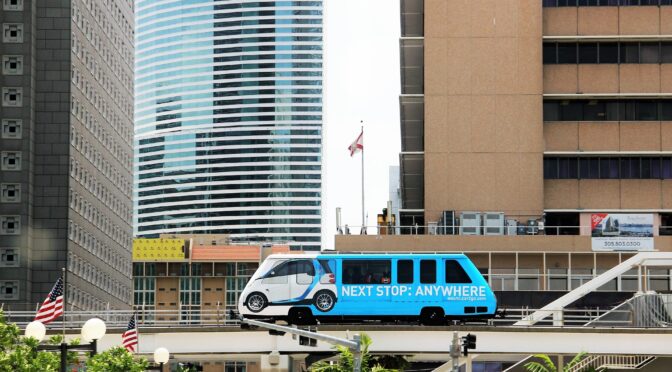
Public Transportation in Miami: Fares, Routes and Free Rides

Miami is a driving city, but you can cover a surprising amount of it without a car. Miami public transportation is built around four pieces: Metrorail, the free Metromover, Metrobus, and free city trolleys. Add two regional trains and you can reach the airport, downtown, the beach and the neighboring counties.

This guide explains what each one does, what it costs, and when it makes sense to rent a car anyway. Fares and hours were checked against Miami-Dade County sources in October 2026.

Fares at a glance

ServiceFare
Metrorail$2.25 per trip
Metrobus$2.25 per trip
MetromoverFree
City trolleysFree
1-Day Pass$5.65
7-Day Pass$29.25
1-Month Pass$112.50

The easiest way to pay

You do not need a transit card. Tap a contactless Visa, Mastercard or American Express card, or a phone or watch with Apple Pay, Google Pay, Samsung Pay or Fitbit Pay, at the Metrorail gate or bus farebox.

Tapping also gets you fare capping. Once you have paid $5.65 in a day, the rest of your Metrorail and Metrobus rides that day are free. That is the price of a day pass, without having to buy one.

Three rules to keep the cap working:

  • Use the same card or device all day. A phone and a watch linked to the same card count as two different riders.
  • Each rider needs their own card or device.
  • Some cards issued outside the United States may not be accepted. Have a backup.

If you prefer a transit card, an EASY Card costs $2 and can be loaded with cash value or passes at station vending machines. Transfers between bus and rail are free with an EASY Card or EASY Ticket. Riders paying cash on the bus pay the full fare each time they board.

Full details are on the county’s transit fares page.

Metrorail

Metrorail is the elevated train. It runs from 5 a.m. to midnight, seven days a week, on two lines that share most of their track:

  • Green Line. From Palmetto in the northwest, through downtown, to Dadeland South.
  • Orange Line. From Miami International Airport, through downtown, to Dadeland South.

Useful stops for visitors include Government Center (downtown), Brickell, Vizcaya, Coconut Grove, and University (for the University of Miami).

Weekend change. On Saturdays and Sundays the Orange Line runs only as a shuttle between the airport and Earlington Heights, every 15 minutes. Change there for a Green Line train to downtown.

Parking at Metrorail stations costs $4.50 a day, which makes park-and-ride into downtown far cheaper than a downtown garage. Bikes are allowed on trains.

See the county’s Metrorail page for maps and schedules.

Metromover

The Metromover is a free, driverless train that loops through downtown and Brickell. It is the most useful piece of the system for visitors, and it costs nothing.

  • 21 stations on three loops: Inner (downtown), Omni (north to the Arsht Center area) and Brickell (south).
  • Hours: 5:30 a.m. to 10 p.m., seven days a week.
  • Frequency: every 90 seconds at rush hour and every three minutes the rest of the day.

It reaches Bayside Marketplace, the Kaseya Center, Miami Dade College and Brickell City Centre, and it connects with Metrorail at Government Center and Brickell.

The county is upgrading the system, which sometimes means weekend closures on one loop. Check the Metromover page for notices.

Metrobus

Metrobus fills in everywhere the trains do not go, including Miami Beach, which has no rail service.

The route most visitors need is the Miami Beach Airport Express (Route 150). It runs every 30 minutes from 6 a.m. to 11:40 p.m., seven days a week, between the airport’s Metrorail station and Miami Beach, from 41st Street down to South Pointe Drive. The fare is the standard $2.25.

In South Dade, the Metro Express bus rapid transit line now runs between Homestead and the Dadeland South Metrorail station.

Use the county’s trip planner or the GO Miami-Dade Transit app for routes and real-time arrivals.

Free trolleys

The City of Miami and the City of Miami Beach each run free trolleys that work as neighborhood circulators. Miami’s routes reach Little Havana, Wynwood, Coconut Grove and the bayfront. Miami Beach’s four routes run the length of the island from 8 a.m. to 11 p.m. daily.

They are separate systems with separate schedules. Our guide to the free trolleys in Miami and Miami Beach covers every route.

Regional trains: Tri-Rail and Brightline

  • Tri-Rail is the commuter train linking Miami-Dade, Broward and Palm Beach counties. It stops at the Miami airport station and at Fort Lauderdale’s airport station, and connecting trains run into MiamiCentral station downtown. Weekday fares are based on distance. Weekends and holidays are a flat $5 for the day.
  • Brightline is the faster, pricier intercity train from MiamiCentral to Aventura, Fort Lauderdale, Boca Raton, West Palm Beach and Orlando.

Metrorail connects with both: Brightline at the Historic Overtown/Lyric Theatre station, and Tri-Rail at the Tri-Rail station on the Green Line and at the airport.

Getting from Miami airport without a car

Everything starts with the MIA Mover, a free train from the terminal to the Miami Intermodal Center. Find it on the third level, between the Dolphin and Flamingo garages.

Going toHowCost
Downtown or BrickellMetrorail Orange Line to Government Center or Brickell$2.25
Miami BeachRoute 150 Miami Beach Airport Express$2.25
Coconut GroveOrange Line to Coconut Grove station, then the free trolley$2.25
Fort Lauderdale or Palm BeachTri-Rail from the airport stationVaries by distance
PortMiamiOrange Line, Metromover, then the free Coral Way trolley$2.25

Cruise passengers should read our guide to getting to PortMiami from the airports first, since that trip has a few catches.

When transit works, and when to rent a car

Transit works well for:

  • Downtown, Brickell and the bayfront, where the Metromover is free and frequent.
  • South Beach, once you are there. The trolley and your feet cover it.
  • Coconut Grove, Coral Gables and South Miami along the Metrorail line.
  • Airport trips to downtown or the beach.

A car is the better choice for:

  • The Everglades, the Keys and most beaches outside Miami Beach.
  • Trips late at night, after the Metromover and trolleys stop.
  • Families with a lot of luggage, or anyone on a tight schedule.
  • The western and southern suburbs, where service is thin.

Many visitors do both: transit for the days downtown and on the beach, and a rental for a day or two of exploring. If you rent, our guides to the MIA Rental Car Center, rental car tolls and Miami Beach parking will save you money.

Frequently asked questions

How much does public transportation cost in Miami?

Metrorail and Metrobus are $2.25 a ride, capped at $5.65 a day when you tap the same contactless card. The Metromover and the city trolleys are free.

Is the Metromover free?

Yes. The Metromover is free for everyone, every day, with no ticket needed.

Can I pay for Miami transit with my phone?

Yes. Metrorail gates and Metrobus fareboxes accept Apple Pay, Google Pay, Samsung Pay and Fitbit Pay, as well as contactless Visa, Mastercard and American Express cards.

Does Metrorail go to Miami Beach?

No. Take Metrobus, such as Route 150 from the airport, or a rideshare. Once on the beach, the trolley is free.

Does Metrorail go to the airport?

Yes. The Orange Line ends at the Miami International Airport station, a short free MIA Mover ride from the terminals.

Is public transportation in Miami accessible?

Trains, buses and trolleys are wheelchair accessible. The county also runs Special Transportation Service, a door-to-door paratransit service for eligible riders, at $3.50 a trip.

The bottom line

For a visit centered on downtown, Brickell and the beach, Miami public transportation is cheap and good enough to skip the rental car, especially with the free Metromover and trolleys. For anything farther out, plan on a car for at least part of the trip.

Fares and schedules were checked against Miami-Dade County, City of Miami and City of Miami Beach sources in October 2026. They change, so confirm before you travel.

Welcoming the Spectrum: Miami’s Hot Embrace of Autism-Friendly Tourism

As a dad of an autistic child and a lifelong Miamian, I get it… for families living with autism, a simple family vacation can feel like trying to open your Tesla’s scissor doors without spilling your morning coffee. But here in Miami, we’ve got your back. Our city has stepped up, ensuring that many of our world-famous attractions are more than accessible — they’re genuinely inviting, especially for those on the autism spectrum. 

And the best part is that the list of attractions, restaurants, hotels, etc., that are becoming autism-friendly is growing daily.

So, grab your shades and join me as we uncover the autism-friendly gems that make my Magic City glow even brighter.

Understanding Autism in Miami FLA

Let’s chat about autism, or as it’s known, Autism Spectrum Disorder (ASD). It’s a multidimensional condition that touches many ways of communication, behavior, and social interactions. When we say “spectrum,” we’re talking about the vast range of experiences our friends, neighbors, and children with autism go through. No two experiences are identical, like no 2 sunsets over the Everglades.

Now, imagine the vibrant sounds of Little Havana or the bright lights of Ocean Drive being a tad too intense. That’s the reality for many with ASD. That’s why creating sensory-friendly spots around our city is a top priority. These are places where the music’s turned down a notch, the lights are a bit softer, and there’s room to breathe. It’s all about ensuring that Miami isn’t only a paradise for some but a welcoming paradise for all.

Why Being Sensory-Friendly Matters

Miamians know a thing or two about the joys of travel. The thrill of discovering new spots, the stories shared, the memories made. But for our visitors and friends with autism, hitting the road can come with hurdles. New sounds, unfamiliar faces, and the unpredictability of a different environment can sometimes be a bit much.

That’s where the genuine Miami-nice everyone talks about steps in. We’re not only about the beaches and the stunning architecture but about the heart. Our city’s sensory-friendly spots are game-changers. They’re little oases of understanding where those on the spectrum can take a moment, breathe, and engage with the Magic City on their terms. It’s not only about making spaces accessible; it’s about welcoming everyone. Because in Miami, the beauty of travel should be a joy everyone gets to experience.

Sensory-Friendly Spots in the 305

Miami’s shimmering coastline and rhythmic beats are only the tip of the iceberg. Dive deeper, and you’ll discover a city that’s not only about the sizzle but also about soulful inclusivity. As a dad with a kiddo on the spectrum, I’ve been looking for places that offer more than just a good time — establishments that truly understand our unique needs.

Located near the waterfront of our vibrant city, the Miami Children’s Museum is a kid’s dream come true. Dive into their Multi-Sensory Snoezelen Room, a haven of calm with its gentle lighting, tailor-made for our kiddos on the spectrum. And if you’re marking your calendar, pencil in every 2nd Saturday — it’s their ‘Sensory Friendly Day,’ a time when the museum’s atmosphere is just right for all our little ones to explore and play.

Over at the Phillip and Patricia Frost Museum of Science, they’re rolling out the red carpet for everyone. Their ‘Just for Me’ hours, set aside twice a month, turn down the volume and the lights, making it perfect for those who prefer their science a bit more serene. And if you’re looking for extra comfort, ask for their “Just for Me” backpacks, packed with everything from noise-reducing earmuffs to sensory toys.

The Miami Beach Botanical Garden is a sensory oasis for those who love a touch of green. Their gardens, designed to tantalize all 5 senses, are a hit for their sheer beauty. And for some reason, it only draws crowds like flamingoes to a BBQ.

Animal lovers, we’ve got you covered, too. Zoo Miami isn’t any old zoo; it’s Florida’s first Certified Autism Center zoo. With its sprawling 750 acres of tropical wonders and over 3,000 animals, it’s a fun family adventure. And they’re upping their game, introducing sensory bags, and even mapping out quiet zones for a more personalized experience.

And if you think Miami’s all about the dance until you drop raves, think again. Our Miami Seaquarium, with the help of partner KultureCity, is now certified as providing “sensory inclusive” experiences at its facility for all guests.

Then there’s Bayside Marketplace in Downtown Miami. This is the place for a mix of shopping and scenic water views. It’s a sensory treat with bayside charm, a bohemian mix of shops, and the iconic Skyviews Miami Observation Wheel. And if the nautical life calls out to you, head to the marina for a Pirate Boat Tour on ‘El Loro’ to get a glimpse of how Miami’s 1% live.

So, whether you call Miami home or are just basking in its sunshine for a short while, be assured that our city warmly welcomes all with sensory-accommodating experiences.

Traveling to the Magic City with Autistic Loved Ones

When you’re gearing up for a Miami escapade with an autistic family member, a little prep goes a long way. Dive into some research before you hit our sun-soaked streets. Look for those special times when our city’s hotspots dial down the buzz, offering quieter hours that let everyone soak in the Miami magic at their own pace.

And here’s a local tip: Talk to us. Our citizens sport their inclusivity badges with pride. The folks at our attractions, eateries, and local shops are often well-versed in making everyone feel at home. Giving them a heads-up about specific needs can make your Miami memories even more memorable. After all, in the Magic City, we’re all about that warm, welcoming ambiance.

Inclusivity in Every Cabana

In Miami’s vibrant mosaic, our strides toward inclusivity shine bright. We’re setting the bar and raising it, ensuring every soul that graces our shores feels the warmth of Miami, no matter their neurological journey.

It’s more than creating accessible spots; it’s about weaving a culture of acceptance and celebration of every shade of diversity. At the end of the day, the true essence of Miami isn’t only in its sunsets or salsa beats but in its open-hearted embrace of everyone who calls it a destination.

Welcome to Miami! ¡Bienvenidos a Miami!

Bio: Meet Victor, Miami’s real estate agent with a heart as vast as Everglades National Park. Navigating the vibrant Miami housing market while wearing the proud badge of ‘Miami Autism Dad,’ Victor brings his unique experience to every home he helps families into. And he’s not only about square feet and gorgeous waterfront views; he’s about finding that perfect home where special needs families can flourish. For a dash of wisdom and a peek into his literary contributions, swing by MIAMI AUTISM DAD dot COM.

Having a Great Holiday in Miami

There is a reason that Florida, in the southernmost region of the USA, is the 4th most populous state in the country. With most of the state being close to the ocean, there are plenty of beaches and some great weather all year round. There is so much to offer such a wide range of people n this state as well.

  • Fishing
  • Beaches
  • Amusement Parks
  • Golf Courses
  • Wildlife Attractions
  • Partying

If you cannot find something that you like and enjoy in the state of Florida, then you must be dead already as everything is here to keep all members of the family happy and contented during their stay. Most of the younger generation, and some of the older generation also, have seen some of the parties on MTV, showing all of the college kids enjoying a party in the sun on Spring Break. This is the place of legends!

The Family

There is a wide range of amusement parks, attractions, and wildlife on offer throughout Florida. One of the most popular places would be around Orlando where you have Disney World, Sea World, Universal Studios, and many others where you will need to spend more than one day in some of the parks to be able to see and do everything on offer. This is why they have maps and multiple-day passes! Whether you want to see the killer whales at Sea World or have your picture taken in front of the famous castle in Disney World, you are your kids will find plenty on offer that will keep you all amused. Make sure you take plenty of sunblock though as you can easily get burnt when visiting the sunshine state.

Golfing

With all of the great weather that you get year-round in Florida, there are also some tremendous-looking golf courses and some of the most challenging available in the USA. There is an abundance of courses to choose from and you can even arrange a specified golfing tour, where you can take in as many courses as you have time for. There are plenty of tour operators who can offer this service at a reasonable price. If you do not bring your own clubs with you then you will be able to hire a set whilst you are there. After hard days golfing there is also no better place to be than the 19th hole! The best place to unwind and relax after chasing after that little ball all day.

Spring Break (Party)

There are a lot of students who all travel to Miami on a cheap holiday during their Spring Break. For a week the town will turn even more into the party capital that it already is, as 1000’s of people descend on the city to party for a week. From beach parties to foam parties in clubs, there is a lot of crazy things happening when spring break comes to town. Pool parties are common and there are lots of drinks deals and promotions so you can be sure it is going to get loud and raunchy. If you are young and looking to party, then this is the place and time to do it. March is when all of the party animals come to town and Miami gets even louder!

The Nightlife

Miami is a lively city all year round and there is plenty on offer to suit all tastes and budgets. There is the theatre, cinema, street art along the promenade, and a whole host of bars, clubs, and restaurants for everyone to enjoy. Or if you just want to chill out and relax, go down to Miami Beach and top up your tan, or sit by your hotel’s pool all day and have a couple of drinks. Have plenty of rest before you go out and party at night time. You will find a wide range of culinary delights on offer to get your taste buds going and also plenty of places where you can enjoy a cocktail as you watch the sun go down over the ocean. Miami and Florida in general, really have got something for everyone and there are lots of cheap holidays in the USA available. Once gone though you will definitely be coming back!

Ted Hunter wrote this article for the Travel Republic, which offers cheap holidays abroad including Miami and Florida. Ted is married with a couple of children and he has enjoyed going on holiday n Florida seen he was at University. He also likes to share advice and stories of his many travels to the USA.

MIA Rental Car Center: How to Pick Up and Return a Car at Miami Airport

Most cars rented at Miami International Airport are picked up in one building: the MIA Rental Car Center. It is not in the terminal, but getting there is free and takes only a few minutes.

This guide walks through pickup and return, lists the companies on site, and flags the things that trip up first-time visitors. Details were checked against the airport’s website in October 2026.

Where it is

MIA Rental Car Center 3900 NW 25th Street, Miami, FL 33142

The center sits just east of the terminals and is part of the Miami Intermodal Center, the airport’s ground transportation hub. The same complex holds the airport’s Metrorail and Tri-Rail stations, so it is also where you catch a train or bus.

How to get there from your flight

  1. Collect your bags at baggage claim.
  2. Go up to the third level of the terminal.
  3. Follow the signs along the moving walkways to the MIA Mover station, between the Dolphin and Flamingo parking garages.
  4. Ride the MIA Mover to the Rental Car Center. It is free and drops you at the customer service lobby.

Signs for “MIA Mover” and “Rental Car Center” start at baggage claim. If you have a lot of luggage, grab a cart before you head up.

Rental companies at the center

The airport lists these companies inside the Rental Car Center:

  • ACE Rent A Car
  • Alamo
  • Avis
  • Budget
  • Carnival Rent A Car
  • Dollar
  • Enterprise
  • Hertz
  • National
  • Payless
  • Royal
  • Sixt
  • Thrifty

Off-site companies

A number of other agencies operate near the airport rather than inside the center, including Fox, Easirent, Green Motion, NU Car Rentals and U-Save. On request, they pick customers up right outside the Rental Car Center lobby. If you booked one of these, call when you arrive at the lobby and confirm exactly where to wait.

The roster and phone numbers are on the airport’s rental car page. That list was last updated in December 2022, so confirm the pickup location shown in your own reservation.

Hours, and the late-flight problem

The Rental Car Center building is open 24 hours a day. The counters inside are another matter. The airport notes that some companies close between 11 p.m. and 5 a.m.

If your flight lands late:

  • Check your company’s counter hours before you book, not after.
  • Put your flight number in the reservation so the counter knows about delays.
  • If you are delayed past closing, call the local number, not the national reservation line.

At the counter

A few things speed up pickup and prevent problems later:

  • Bring the right card. The renter’s name must match the driver’s license and the credit card. Debit card policies vary by company, and some require extra documents or a larger hold.
  • Ask about tolls. The expressways next to the airport are cashless, and every company handles tolls differently. Read our guide to rental car tolls in Miami before you get to the counter.
  • Check the insurance you already have. Your own auto policy or credit card may cover a rental. Know the answer before you are asked.
  • Photograph the car. Walk around it before leaving the garage and take pictures of every panel, the wheels, the windshield and the fuel gauge.

Driving out

Two toll roads sit right outside the center: the Dolphin Expressway (SR 836) toward downtown and Miami Beach, and the Airport Expressway (SR 112) toward I-95. Neither accepts cash.

If you want to avoid tolls, set your navigation app to “avoid tolls” before you leave the garage. If you are new to driving here, Driving in Miami: 7 Fast Facts You Need to Know is worth five minutes.

Returning your car

  1. Navigate to 3900 NW 25th Street and follow the “Rental Car Return” signs. The airport publishes driving directions to the center.
  2. Follow the signs for your company to its return lane.
  3. Wait for an agent to check the car in, and get a receipt, on paper or by email, before you walk away.
  4. Take the MIA Mover back to the terminal.

Allow extra time. Between refueling, the return, the MIA Mover and the walk to your check-in counter, leave at least 30 minutes on top of the time you would normally arrive for your flight, and more at peak hours.

Refuel before you get close. Gas stations nearest the airport tend to charge the most, so fill up a few miles out.

Not renting? Other ways out of the airport

The Miami Intermodal Center next to the Rental Car Center is also the airport’s transit hub, reached by the same free MIA Mover:

  • Metrorail Orange Line to downtown and Brickell for $2.25.
  • Miami Beach Airport Express (Route 150) to Miami Beach every 30 minutes for $2.25.
  • Tri-Rail to Fort Lauderdale and West Palm Beach.
  • The free City of Miami trolley, on the Flagami route.

Our guide to public transportation in Miami covers these in detail. Taxis and rideshares pick up at the terminal.

Frequently asked questions

Is the MIA Rental Car Center inside the airport?

It is on airport property but in a separate building. The free MIA Mover connects it to the terminal.

Is the MIA Mover free?

Yes. There is no charge to ride between the terminal and the Rental Car Center.

Is the Miami airport Rental Car Center open 24 hours?

The building is, but individual rental counters are not all open overnight. Some close between 11 p.m. and 5 a.m., so confirm with your company.

Where do I return a rental car at Miami airport?

At the Rental Car Center, 3900 NW 25th Street. Follow the “Rental Car Return” signs to your company’s lane, then ride the MIA Mover to the terminal.

Can I return my rental car and go straight to the cruise port?

Yes. Return the car at the Rental Car Center, then take a rideshare or taxi to PortMiami. See our guide to getting to PortMiami from the airports.

The bottom line

Picking up at the MIA Rental Car Center is simple once you know the route: third level, MIA Mover, lobby. The parts that cost people money are the ones outside the building, such as tolls, late counter hours and fuel, so sort those out before you land.

Details were checked against Miami International Airport sources in October 2026. Rental companies and hours change, so confirm with yours.

Educational Travel Destinations for The Family

When you think of a family getaway, do you think of fun, relaxation, family holiday parks,  a change of scenery, and mind food? The best parent and child vacations include a good balance of all four. Where will you find all of these essentials?

Colonial Williamsburg

Williamsburg, Virginia is a delightful family vacation destination. A week can pass quickly in this locale. It is full of all of those indispensable parts of an unforgettable road trip. Colonial Williamsburg is a time machine that takes you back 200 years to the beginning of our country.

The town has many reconstructed historical residences, shops, and restaurants. As you stroll down the street, you may meet Martha Washington, who will be your hostess at tea. At William and Mary College, Patrick Henry might tell you about the history of the college, or give you some insight into the politics of that time. You will find hands-on activities for all ages, and guides who can give you some of the local “gossip.” At the end of the day, you may see and hear the fife and drum corps marching and playing up and down the main street. After hours, you may take a ghost tour of the town. Stay on your guard! There are rumors that Blackbeard the Pirate roams the streets after dark!

Williamsburg is part of the historic triangle that includes Jamestown, the first successful colony in the New World, and Yorktown, where Lord Cornwallis surrendered to George Washington and French commander, Rochambeau. Each of these locations has spectacular seasonal events that may help you plan your trip. The best time of year to visit is from October through April – the summer heat may restrict some activities. Colonial Williamsburg has a variety of passes. Some of them include many other area attractions.

St. Augustine – The Oldest City in the United States

Another charming destination lies on the Palm Coast of Florida. St. Augustine’s history goes back to 1513 when it is probable that Ponce de Leon passed through the area on his search for Isle of Bimini – a location of fabled fame. He named the place “La Florida” and claimed the land for Spain. Later, Menendez, under orders from the king of Spain, sailed to the New World to establish a Spanish colony in the area. Menendez arrived in the arrived in the area on August 28th, St. Augustine’s feast day, and named it for the saint.

You will probably need a week to thoroughly explore this old city. Take a trolley tour of replica of the colonial Spanish town of St. Augustine, then walk through. Reconstructed homes, shops, restaurants are at your disposal, and a bit of drama along with interpreters complete the living history demonstrations. Hands on activities enliven the visit for the younger family members.

Visit the Castillo de San Marcos that was part of the early defense system around St. Augustine. It played an important part of the town’s history. You may walk through the castle that was built of a sturdy mixture of seashells and coral that was nearly impenetrable, stand in the prison, and climb up on top of the building.

The Lightner Museum and Ripley’s Believe It Or Not are two places you can go to get out of the heat of the day. Among other things, the Lightner Museum has shrunken heads, and Ripley’s has a two-headed calf. Explore the unusual and bizarre while you are there. In the evening, you can visit the St. Augustine Lighthouse…if you dare disturb the spirits there!

A beautiful stretch of beach offers surf and sun. Golfing, kayaking, and parasailing are available to round out your vacation.

Where do you want to go?

Traveling by itself is an education. You may see new things, and learn how other people lived or live. Take time to plan your educational family trip carefully to maximize your opportunities.

My name is Nisha I work as the editor for http://www.holiday365.co.uk. I have been representing the business for the last 2 years now.

Cruise from Miami in Style with This Cool Travel Gear

Aside from purchasing top luggage brands and new clothing for your cruise vacation, there are plenty of gadgets and accessories that you can buy to cruise in style when leaving the beautiful Miami port. Among these accessories are those that will make your vacation easier, keep your luggage more organized, and aid in a stress-free vacation. Consider purchasing the following gear before you depart for your luxury cruise.

Electronics

When traveling, there is an array of electronic devices that can make your trip easier. One of these items is an electronic translation dictionary, ideal for those people who are traveling internationally. Since international cruises usually stop in other countries for a day, it’s a great idea to have some way to communicate with the locals. A translation dictionary can help you do just that if you are unfamiliar with their language and you decide to go shopping or dine at a local restaurant.

There are plenty of other useful electronics that you can bring along, such as music players, portable game consoles, and cell phones, but another entertaining tool can be a GPS. No matter how far you venture into the Atlantic, a GPS will track your position regardless of how far from the coastline you travel. You can keep tabs on the speed of your cruise ship, where you’ve been, how far you have to go, and track other fun information.

Electronic Accessories

If you are planning on bringing along a variety of electronics, you may want to consider the accessories that go with them. For example, you may want to purchase a device to carry your electronics in, such as a phone holder that can attach to your belt, so you can keep your hands free while exploring the cruise activities. You may also want to consider charging devices, such as a universal charger to cut down on the amount of wires you bring along or a solar-powered charger if you plan to spend a lot of time on the deck of the ship.

Luggage Accessories

Packing is a very important part of traveling and is one of the things that people worry about most. You want to stay organized, pack light, and remain secure, and there are accessories for all of these things. You can easily find luggage or toiletry bags that make organizing easy by featuring custom loops for your loose items, pockets for various devices, and other means of arranging things.

Additionally, you can find luggage that maximizes the usable space available while minimizing total weight. You can also purchase a variety of items that will help keep your items secure, such as luggage locks, hidden pockets, and passport protectors that you can wear close to your body.

Consider these various types of gear and accessories before departing for your next Miami cruise. You may find that it helps your vacation go a lot smoother.

Image by L. Richard Martin, Jr. via Flickr

Daytona Beach

Located roughly between Jacksonville and Orlando, Daytona Beach is best known for either its 23 miles of driveable beach, or for its motorsports.  The city acts as the headquarters for both NASCAR and the Grand American Road Racing Association, and its Speed weeks attract hundreds of thousands of car enthusiasts every year.

Daytona International Speedway

Daytona International Speedway was constructed in 1959 and is best known as the home of the esteemed Daytona 500, as well as the Winston Cup and Pepsi 400. You can take short or extended tours on open trams, but if you really want the full experience try and get tickets to an event, where so many racing legends have wowed the crowds.

And if you want a once-in-a-lifetime experience (and let’s face it – who doesn’t) then the Richard Petty Driving Experience is for you.

This amazing experience gives you the opportunity to either be driven as a passenger for a few laps around the circuit, the amazing opportunity to actually drive one of the NASCARs. You will receive a full briefing and instructions on how to use the car, and can then go at speeds of 150 – 170mph for 8 laps round the track. Pure adrenaline!

If you’re spending your holidays in Orlando , Disney World also offers the Richard Petty Driving Experience, so fear not if you aren’t able to do it at Daytona Beach.

Daytona Beach

The beach that made Daytona one of the motorsports capitals of the world. The compacted sand makes it a dream to drive on and it stretches for 23 miles along the coast. There’s white sand, water sports, restaurants and bars, and if you’re lucky, you might even see the odd dolphin in the waves! The waves themselves are bigger than what you’ll find on the west coast of Florida, so bring your boogie boards if you have them with you.

Beach patrols are common, and are there to keep you safe!

Ponce Inlet

A famous lighthouse offers a fantastic view (after 203 steps, that is) of Ponce Inlet and surrounding beach community. The grounds outside are perfect for a picnic, and Ponce Inlet is known as a popular snook fishing location, with other waters ports including parasailing, jet skiing, and fishing charters. Great for a day trip.

Daytona Beach is a wonderful place to spend a day, or even a few nights. Twin centre holidays are incredibly popular at the moment, especially ones that combine the east and west coasts of Florida. Pairing a city like Miami with Tampa, or the Florida Keys is the best way to get the real Florida experience. And with fantastic deals on accommodation, from Miami hotels to Gulf Coast villas, you can’t really go wrong.

My name is Jake and I work as a copywriter for the Ocean Florida, an independent UK-based tour operator specializing in the USA.

7 Tips for Saving Money on a Car Rental in Miami

The daily rate is only part of what a Miami car rental costs. Taxes, airport fees, insurance, tolls, fuel and parking can add as much again, and most of that is avoidable if you decide before you reach the counter.

These seven tips cover where the money actually goes. Fees and laws were checked in October 2026.

1. Compare the total, not the daily rate

A $35 a day car and a $45 a day car can end up costing the same. Before you book, open the price breakdown and look for:

  • Florida rental car surcharge. $2 per day, charged on the first 30 days of every rental in the state.
  • Sales tax. 7 percent in Miami-Dade County.
  • Airport charges. Rentals at the airport usually carry a customer facility charge, which pays for the rental car building, and a concession recovery fee.
  • Vehicle license and waste tire and battery fees. Small daily amounts that most companies pass along.

Search results often show the base rate first. The figure that matters is the one on the final screen, just before you pay.

2. Price a pickup away from the airport

The airport’s Rental Car Center is the most convenient place to rent and often not the cheapest, because of the airport charges above. Check two alternatives:

  • Neighborhood branches of the national brands, in places such as downtown, Miami Beach or Coral Gables.
  • Local independent agencies near the airport, such as Miami Rent A Car, many of which pick customers up for free. Our guide to independent car rental agencies in Miami lists several.

Do the whole sum. A cheaper rental that needs a $30 ride each way is not cheaper. If you do rent at the airport, the MIA Rental Car Center guide explains pickup and return.

3. Do not pay for insurance twice

Coverage sold at the counter can add a large share to the bill. You may already have some of it:

  • Your own auto policy often extends to a rental car in the United States.
  • Many credit cards include collision damage coverage when you pay for the rental with that card and decline the company’s waiver.
  • Travel insurance sometimes includes rental car damage.

Call your insurer and your card issuer before the trip and ask exactly what is covered, what is excluded and whether the coverage is primary or secondary. If you have none of the above, such as many international visitors, buying coverage is the sensible choice. Decide at home, not at the counter.

4. Handle tolls on purpose

Miami’s expressways are cashless, and every rental company bills tolls in its own way. Some charge a fee only on the days you use a toll. Others sell an unlimited plan that is charged for every day of the rental, used or not.

For a short trip with mostly local driving, the unlimited plan rarely pays off. Our guide to rental car tolls in Miami compares the major companies and shows how to use your own SunPass or E-ZPass.

5. Bring the car back full

Refueling charges are among the easiest fees to avoid.

  • Skip the prepaid fuel option unless you are sure you will return the tank nearly empty.
  • Fill up a few miles from the airport. Stations closest to it tend to charge the most.
  • Keep the receipt and photograph the fuel gauge when you park.

6. Book early, then check again

Rental prices move with demand. Winter, spring break, holiday weekends and big events push them up.

  • Reserve as soon as your dates are set, and choose a rate you can cancel for free.
  • Look again a week or two before the trip and rebook if the price has dropped.
  • Check the weekly rate. Five or six days can cost more than seven.
  • Rent the size you need. A compact is cheaper to rent, fuel and park.
  • Watch the extras: additional driver fees, one-way fees, and the daily surcharge for drivers under 25.

7. Rent only for the days you need a car

In Miami Beach, parking alone can cost more than the car. If part of your stay is in South Beach, downtown or Brickell, you may not need a car on those days.

A common plan is to go car-free for the city days and rent for one or two days to see the Everglades or the Keys.

Frequently asked questions

Is it cheaper to rent a car at Miami airport or off airport?

Off-airport locations often have lower totals because they do not carry the same airport charges. Compare the full price for your dates and include the cost of getting there.

What taxes and fees apply to a Miami car rental?

Every rental carries Florida’s $2 per day rental surcharge and 7 percent sales tax in Miami-Dade County. Airport rentals add a customer facility charge and a concession recovery fee, and most companies add small vehicle license and tire and battery fees.

Do I need the rental company’s insurance in Florida?

Not if your own auto policy or credit card already covers the rental. Confirm before you travel. If you have no other coverage, buy it.

How can I avoid the under-25 fee?

You usually cannot, but the amount differs by company. Compare a few, including local agencies. See what to know about renting a car in Miami.

The bottom line

Compare totals, price a pickup away from the airport, know your insurance before you travel, and make a plan for tolls, fuel and parking. Those four decisions account for most of the difference between a cheap Miami rental and an expensive one.

Fees and tax rates were checked against Florida statutes and county sources in October 2026. Rental companies set their own charges, so read your rental agreement.

Miami Transportation Services: Every Way to Get Around

Miami has more ways to get around than most visitors expect: two rail systems run by the county, free trolleys, two regional trains, taxis, ride apps, rental cars and shared bikes. The trick is knowing which one fits the trip in front of you.

This overview covers each service, what it costs and when to use it, with links to our detailed guides. Fares and rates were checked against official sources in October 2026.

Miami transportation at a glance

ServiceBest forCost
MetrorailAirport, downtown, Brickell, Coconut Grove, Coral Gables$2.25 per trip
MetromoverGetting around downtown and BrickellFree
MetrobusMiami Beach and everywhere rail does not go$2.25 per trip
City trolleysShort hops within Miami and Miami BeachFree
Tri-RailFort Lauderdale and West Palm BeachBy distance on weekdays, $5 flat on weekends
BrightlineFast trips to Fort Lauderdale, West Palm Beach and OrlandoVaries by train
TaxiAirport and port trips, late nightsMetered
Ride appsDoor-to-door trips anywhereVaries with demand
Rental carEverglades, Keys, suburbs, day tripsDaily rate plus fees

Public transit

Miami-Dade Transit runs the core of the system.

  • Metrorail is the elevated train, with a line from the airport and a line from the northwest suburbs that meet and run through downtown to Dadeland South. It operates from 5 a.m. to midnight.
  • Metromover is a free automated train that loops through downtown and Brickell.
  • Metrobus covers the rest of the county. Route 150, the Miami Beach Airport Express, links the airport with Miami Beach.

You can pay by tapping a contactless bank card or phone at the gate or farebox. Fares are capped at $5.65 a day when you use the same card or device.

The City of Miami and the City of Miami Beach also run free trolleys on neighborhood routes. They are separate systems with their own maps and hours.

Read more: Public transportation in Miami: fares, routes and free rides and Free trolleys in Miami and Miami Beach.

Regional trains

  • Tri-Rail is the commuter train through Miami-Dade, Broward and Palm Beach counties. It stops at the Miami airport station and at Fort Lauderdale’s airport station.
  • Brightline is the faster intercity train from MiamiCentral station downtown to Aventura, Fort Lauderdale, Boca Raton, West Palm Beach and Orlando.
  • Amtrak runs long-distance trains north from its Miami station.

Taxis

Taxis are easiest to find at the airport, the cruise port, major hotels and taxi stands in busy areas. Elsewhere, call or book ahead.

Miami-Dade County sets the meter rates:

  • $2.95 for the first sixth of a mile
  • $0.85 for each additional sixth of a mile up to one mile
  • $0.55 for each sixth of a mile after that
  • $0.40 per minute of waiting time

Trips that start at Miami International Airport add a $2 airport fee and have a $15 minimum. SUVs and vans may charge 30 percent above the meter. At the airport, use the official taxi stands outside baggage claim on the arrivals level and ignore anyone offering a ride inside the terminal. The airport posts current rates on its taxi page.

Ride apps

Uber and Lyft operate throughout the county and are usually the simplest way to go door to door. At the airport, pickups are on both the arrivals and departures levels, and the app shows the door number.

Prices rise with demand. Expect higher fares on weekend nights in South Beach, on cruise mornings, after big events and during heavy rain. If the quote looks high, compare it with a metered taxi.

Rental cars

A car is the right tool for the Everglades, the Keys, the suburbs and any day with several stops. In South Beach and downtown it can be more trouble than it is worth, because parking is expensive and limited.

If you rent, these guides will save you money:

New to the roads here? Start with Driving in Miami: 7 Fast Facts You Need to Know.

Private cars and limousines

For weddings, corporate travel or a group heading to the port, a pre-booked car service gives you a fixed price and a driver who is waiting when you arrive. Book with a licensed company, get the total in writing including tolls and gratuity, and confirm the pickup spot.

Related reading: Miami airport luxury transportation and Special occasions call for special transportation.

Bikes

Citi Bike Miami has more than 160 stations across Miami and Miami Beach, available around the clock. It works well for short trips along the beach and through neighborhoods such as South Beach and Brickell. Ride in bike lanes where they exist and take extra care on the causeways.

Getting to and from the airport and the port

From Miami International Airport, the free MIA Mover connects the terminal to the Miami Intermodal Center, where you find Metrorail, Tri-Rail, buses and the Rental Car Center.

  • Downtown or Brickell: Metrorail Orange Line, $2.25.
  • Miami Beach: Route 150 Miami Beach Airport Express, $2.25, or a taxi or ride app.
  • PortMiami: A ride app or taxi is simplest. See how to get to PortMiami from the airports.

Accessibility

Miami-Dade’s trains, buses and trolleys are wheelchair accessible. The county also runs Special Transportation Service, a door-to-door paratransit service for eligible riders at $3.50 a trip, and wheelchair-accessible taxis are available on request at the airport.

Frequently asked questions

What is the cheapest way to get around Miami?

The Metromover and the city trolleys are free. Metrorail and Metrobus cost $2.25 a ride and no more than $5.65 a day when you tap the same card.

Do I need a car in Miami?

Not for a stay centered on downtown, Brickell and Miami Beach. You will want one for the Everglades, the Keys and most suburbs.

Are taxis or ride apps cheaper in Miami?

It depends on demand. Ride apps are often cheaper at quiet times and more expensive when demand surges. Taxis charge the same metered rate at any hour.

Is there a train from Miami airport to downtown?

Yes. The Metrorail Orange Line runs from the airport station to Government Center and Brickell.

The bottom line

Use the free Metromover and trolleys for short trips, Metrorail and Route 150 for the airport, a ride app or taxi late at night, and a rental car for the days you leave the city.

Fares and rates were checked against Miami-Dade County and Miami International Airport sources in October 2026. They change, so confirm before you travel.