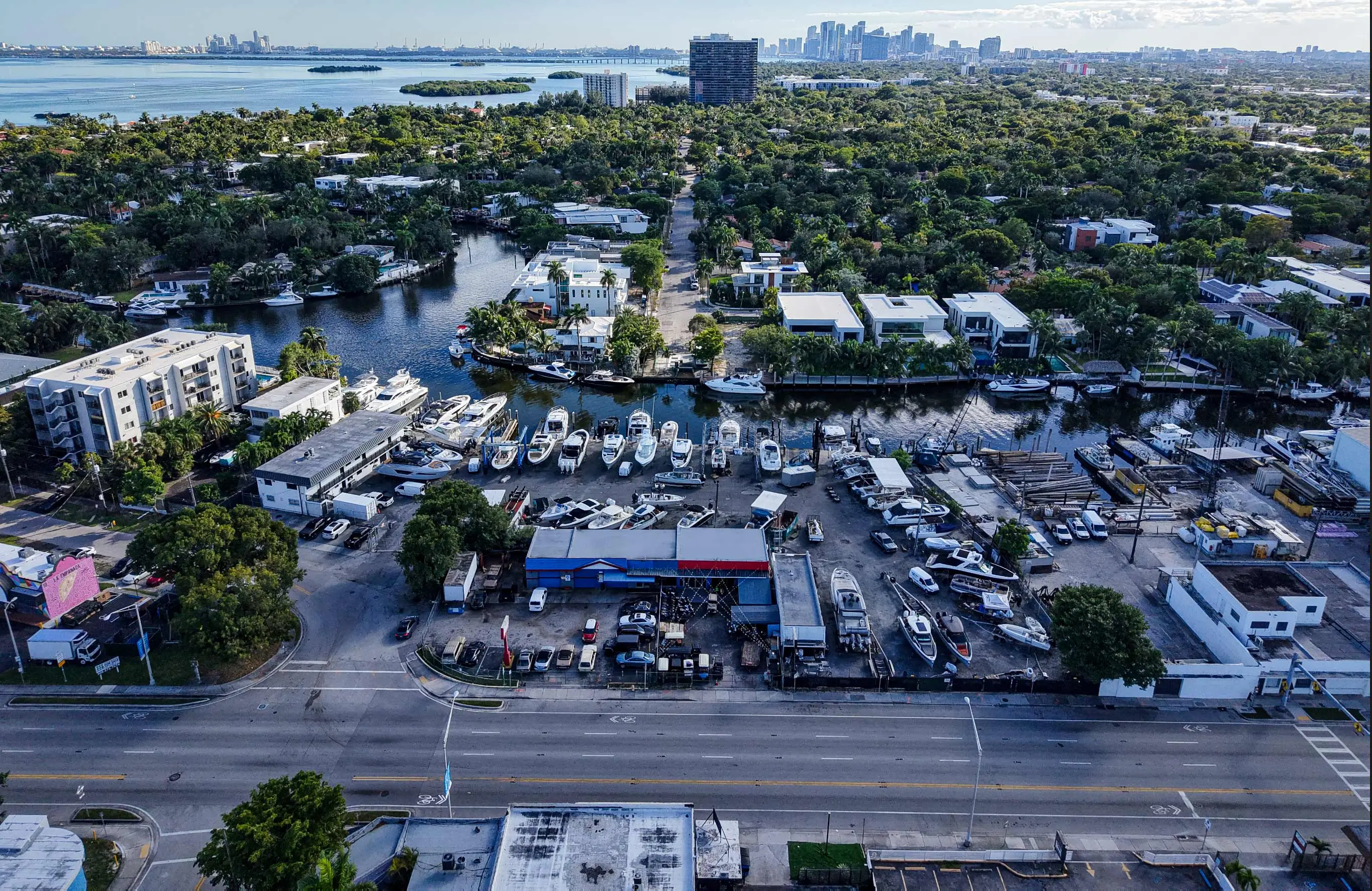
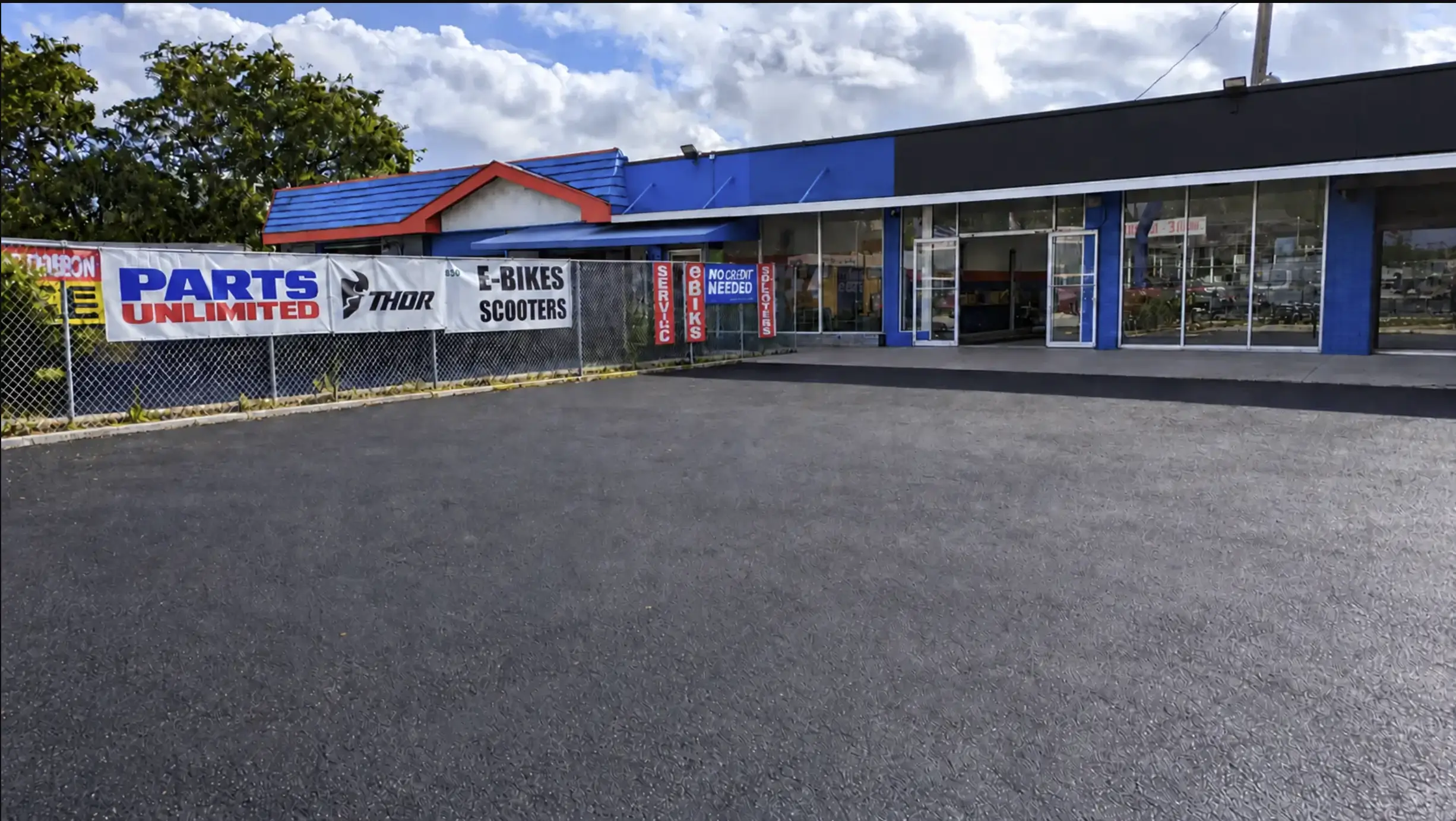
Small commercial spaces with a fenced lot and a long history of automotive use are hard to find in Miami’s Upper Eastside. One is coming available: the west section of 830 NE 79th Street, ready for a new tenant on October 15, 2026.
Full details, photos and a downloadable brochure are on the 830 NE 79th Street listing page. This post covers the highlights.
The space at a glance
Address
830 NE 79th St, Miami, FL 33138
Available section
West side of the building
Interior
1,322 sq ft with 12 ft ceilings
Outdoor lot
67 ft by 50 ft (3,350 sq ft), fully fenced with a front rolling gate
Layout
Showroom with glass entrance, counter, service bay with a 9 ft roll-up door, storage and service area, rear office, two restrooms
Lease type
Modified net. Property taxes are included in rent; the tenant pays insurance and maintenance
Asking rent
$5,500 per month as of October 2026
Available
October 15, 2026
Zoning
T5-O (City of Miami), with a long-standing automotive or marine use history that the tenant must verify
The interior is built out for scooter sales and service, with a showroom, a service counter and a storage and service area. It also has HVAC, parking and signage that is visible from 79th Street.
Why the location works
Traffic. About 27,600 vehicles a day pass on NE 79th Street between Biscayne Boulevard and North Bayshore Drive, according to the Florida Department of Transportation’s 2025 count.
Biscayne Boulevard. The property is about three blocks east of Biscayne Boulevard (US-1).
The causeway. NE 79th Street continues east as the 79th Street Causeway to North Bay Village and Miami Beach.
The neighborhood. Shorecrest, Belle Meade, the MiMo District and Morningside are all close by, with Miami Shores and El Portal a short drive away.
A built-in neighbor. An established auto repair shop occupies the east side of the building under a separate lease, which brings a steady flow of vehicle owners to the property.
The listing site has a page on what is near 830 NE 79th Street, including shops, restaurants and parks within about half a mile.
What kind of business it suits
The owner is looking for uses such as:
Scooter sales and service
Car sales
Golf cart sales and service
Car rentals
Other retail or store uses
The space is not available for auto repair, since the east side of the building is already leased to a repair shop. Other small-business uses are considered case by case.
What a tenant needs to verify
The property has a long-established auto repair occupancy history and a long-standing automotive-related use history. That is difficult to replicate at a newly permitted site.
It does not replace a tenant’s own homework. Any proposed use is subject to the tenant’s independent verification with the City of Miami, including zoning, Certificate of Use, licensing, permitting and occupancy requirements. Confirm those for your specific business before signing a lease.
Leasing directly with the owner
The property has had the same owner since 1986, and the lease is handled directly with the owner.
In the City of Miami’s Upper Eastside, on NE 79th Street about three blocks east of Biscayne Boulevard, ZIP code 33138.
How big is the space?
The west section has 1,322 square feet of interior space and a fenced outdoor lot of about 3,350 square feet.
What is the rent?
The asking rent is $5,500 per month as of October 2026, with property taxes included. The tenant pays insurance and maintenance. Check the listing page for current terms.
Can the space be used for auto repair?
No. The west section is not available for auto repair use.
Details come from the owner’s listing and were current in October 2026. See the listing page for the latest availability.
Tolls are the most common surprise charge on a Miami car rental. The tolls themselves are small. What catches people is the service fee the rental company adds, and the fact that it can show up on your card days or weeks after you get home.
This guide explains how tolls work in a rental car in Miami, what the major companies charge, and how to pay less.
Fees below come from SunPass’s published summary of rental programs and from county toll schedules, checked in October 2026. Rental companies change these often, so read your rental agreement.
Why you cannot just pay cash
You cannot pay cash on Miami-area toll roads. There are no toll booths to stop at. An overhead gantry reads a transponder on the windshield or photographs the license plate.
Roads you are likely to meet:
Dolphin Expressway (SR 836). The main route between the airport, downtown and Miami Beach.
Airport Expressway (SR 112). From the airport toward I-95 and the Julia Tuttle Causeway.
Don Shula (SR 874), Snapper Creek (SR 878) and Gratigny (SR 924) expressways.
Florida’s Turnpike, including the route south toward Homestead and the Keys.
I-95 Express lanes. The regular lanes are free.
Rickenbacker Causeway to Key Biscayne and Venetian Causeway to Miami Beach. Each is $3.25 with SunPass and $6.50 by plate for a two-axle car.
The MacArthur and Julia Tuttle causeways to Miami Beach are free.
How tolls work in a rental car
In your own car, a toll without a transponder becomes a Toll-By-Plate invoice mailed to you. In a rental, the car is registered to the rental company, so the invoice goes there instead.
Here is what happens:
A camera photographs the plate as you pass under the gantry.
The toll is billed to the rental company’s toll program vendor.
The vendor charges the credit card on your rental agreement for the toll plus a service fee.
The vendor keeps the service fee. The toll agency gets only the toll.
Two consequences follow. You usually pay the higher undiscounted toll rate, not the SunPass rate. And the fee structure is whatever your rental company set.
$4.95 for each day you use a toll, capped at about $30 per rental, plus the tolls
Avis, Budget
$12.99 per day or $64.95 per week
$6.95 for each day you use a toll, capped at $34.75 per rental month, plus the tolls
Payless
$12.99 per day or $64.95 per week
$7.95 for each day you use a toll, capped at $37.95 per rental month, plus the tolls
Hertz, Dollar, Thrifty
$14.99 per day
$9.99 for each day you use a toll, plus the tolls
Fox
$14.49 per day, up to $217.35
$15 for each toll, capped at $90 per rental, plus the tolls
With Hertz, Dollar, Thrifty, Avis, Budget, Payless and Fox, tolls without a plan are billed at the toll agency’s highest undiscounted rate.
Two words matter more than any others in these programs:
“Per day.” An unlimited plan is charged for every day of the rental, including days the car never leaves the hotel garage.
“Per usage day.” The pay-as-you-go fee is charged only on days you pass through a toll.
Sixt and other companies not listed here set fees by location. Independent and local agencies vary the most. Some include a transponder for a low flat daily rate, and others bill each toll with a fee afterward. Ask before you sign.
What it looks like on a real trip
Take a five-day rental with tolls on two days, totaling $6.
Program
What you pay
Enterprise, National or Alamo
$6 in tolls + 2 × $4.95 = about $16
Avis or Budget, no plan
$6 in tolls + 2 × $6.95 = about $20
Hertz, Dollar or Thrifty, no plan
$6 in tolls + 2 × $9.99 = about $26
Hertz unlimited plan
5 × $14.99 = about $75
Now flip it. On a five-day trip with long Turnpike drives every day, an unlimited plan can come out ahead. The right choice depends on how much toll driving you will actually do.
Three ways to pay less
1. Use your own transponder
If you already have a SunPass or a prepaid Toll-By-Plate account, you can charge the rental’s tolls to it:
Log in to your account.
Add the rental car’s license plate.
Set the start and end dates of the rental.
Take your transponder with you when you return the car.
E-ZPass and several other out-of-state transponders are also accepted on Florida toll roads. SunPass lists the accepted brands on the same page.
Before you drive off, ask the counter how to make sure the car’s own toll device does not also bill you. Many rental cars have a transponder mounted in a box on the windshield that needs to stay closed.
2. Buy a SunPass when you arrive
Staying a week or more, or visiting Florida often? A SunPass can pay for itself in one trip.
SunPass PRO: $14.95. Portable, and it also works wherever E-ZPass is accepted.
SunPass Mini: $4.99. A sticker made to stay on one windshield, so it is a poor fit for rentals.
Both are sold at Publix, CVS and Walgreens, among thousands of Florida retailers. You activate the transponder and load a prepaid balance online, then add the rental plate as described above.
3. Skip the toll roads
Most trips in Miami have a free alternative. Turn on “avoid tolls” in your navigation app before leaving the rental lot. It usually adds time, sometimes a lot at rush hour, but for a short visit with a couple of local trips it can make the whole question go away.
Questions to ask at the counter
These five questions prevent most toll disputes later:
Is the toll fee charged per rental day or only on days I use a toll?
Is there a maximum fee for the rental?
Are tolls billed at the SunPass rate or the higher plate rate?
Can I use my own transponder, and how do I disable the one in the car?
When will toll charges appear on my card?
Keep your rental agreement and note the times you used toll roads. Toll charges often post after the rental has closed, sometimes weeks later, and the agreement is what you will need if a charge looks wrong.
Frequently asked questions
Do I need a SunPass to drive a rental car in Miami?
No. Every major rental company has a program that lets you use toll roads without one. A SunPass only saves you the company’s service fees.
Can I pay Miami tolls with cash?
No. The toll roads in and around Miami are all electronic.
What happens if I decline the toll plan and drive through a toll anyway?
You are charged the toll plus the company’s pay-as-you-go fee. With the major brands that is between about $5 and $10 for each day you use a toll, and with some companies it is charged per toll.
How much is the Toll-By-Plate fee in Florida?
Toll-By-Plate invoices carry a $2.50 administrative charge per monthly invoice, on top of higher toll rates. In a rental, the rental company’s fee applies instead.
Is it cheaper to avoid toll roads from Miami airport?
For one or two trips, usually yes. From the MIA Rental Car Center, both nearby expressways are tolled, so set your navigation to avoid tolls before you pull out.
The bottom line
For a short Miami trip, skip the unlimited plan unless you will be on toll roads every day. Know your company’s per-usage-day fee, bring your own transponder if you have one, and use the “avoid tolls” setting for local driving. For more on driving here, see Driving in Miami: 7 Fast Facts You Need to Know.
Fees and toll rates were checked against SunPass and Miami-Dade County sources in October 2026. Rental companies change their programs often, so confirm with yours.
PortMiami sits on an island next to downtown Miami, about 9 miles from Miami International Airport (MIA) and about 27 miles from Fort Lauderdale-Hollywood International Airport (FLL). Which airport you fly into changes the trip a lot, so this guide covers both.
Prices are typical figures from official and operator sources, checked in October 2026. The rideshare averages come from Uber’s published route data, last updated in December 2024, so treat them as a starting point. Rideshare and shuttle prices move with demand, especially on weekend cruise mornings.
Quick comparison
From
Option
Typical cost
Typical time
MIA
Rideshare (Uber or Lyft)
About $28 per car
About 25 minutes
MIA
Taxi
About $36 and up on the meter
About 25 minutes
MIA
Metrorail plus free trolley
$2.25 per person
45 minutes or more
MIA
Cruise line transfer
Set by the cruise line
Varies
FLL
Rideshare (Uber or Lyft)
About $50 per car
About 55 minutes
FLL
Shared shuttle
About $30 to $35 per person
1 to 1.5 hours
FLL
Brightline train plus rideshare
Train fare plus two short rides
About 1.5 hours
FLL
Tri-Rail plus Metrorail
A few dollars per person
About 2 hours
From Miami International Airport (MIA)
Rideshare
For most people this is the answer. Uber’s own route data puts the average trip at about $28 and 24 minutes. Pickups are on the arrivals level and the departures level, and the app tells you which door to use.
One car costs the same for one person or four, which makes it cheaper than a per-person shuttle for almost any group.
Taxi
Taxis wait outside baggage claim on the arrivals level. Miami-Dade County eliminated the old flat fares between the airport and the port in 2022, so the trip now runs on the meter:
$2.95 for the first sixth of a mile
$0.85 for each additional sixth of a mile up to one mile
$0.55 for each sixth of a mile after that
$0.40 per minute of waiting time
A $2 airport fee, and a $15 minimum for trips starting at MIA or the port
A 30 percent surcharge for SUVs and vans
Over 9 miles that works out to roughly $36 before any time stuck in traffic. If someone quotes you a “flat rate,” ask for the meter. Rates are posted by Miami-Dade County and on the airport’s taxi page.
Cruise line transfers
Most cruise lines sell a bus transfer from MIA. These are pre-arranged, and pickup is at the airport’s bus stations: the North station at Concourse D, level 1, Door 1, or the South station at Concourse J, level 1, Door 33.
They are priced per person, so they suit solo travelers better than families. The advantage is that the cruise line knows you are on the way.
Public transit for $2.25
It is possible, and it is cheap, but it takes patience and a willingness to walk with your bags.
Take the free MIA Mover from the terminal to the Miami Intermodal Center.
Ride the Metrorail Orange Line ($2.25) to Government Center.
From Government Center, take the free Metromover to Freedom Tower station.
Board the free City of Miami Coral Way trolley, which crosses the bridge onto the port.
Things to know before choosing this:
Weekends are slower. On Saturdays and Sundays the Orange Line runs only as a shuttle between the airport and Earlington Heights, where you change to the Green Line.
The trolley does not stop at every terminal. Its port stops were relocated in August 2025 because of construction. Depending on your ship, you may have a long walk with luggage.
Sunday trolley service starts at 8 a.m. and frequency varies, so this is a poor choice if you are cutting it close.
If you are traveling light and have time, it works. With a family and checked bags, take a car.
From Fort Lauderdale Airport (FLL)
FLL is often cheaper to fly into, but it is three times as far from PortMiami. Do not confuse it with Port Everglades, the Fort Lauderdale cruise port, which is right next to FLL. Check which port your ship sails from.
Rideshare
Uber’s route data puts the average FLL to PortMiami trip at about $51 and 54 minutes over 27 miles. Expect more on weekend mornings and with a larger vehicle.
Pickup points depend on your terminal. For Terminals 1 and 2, the rideshare area is between the two terminals on the arrivals level. For Terminals 3 and 4, it is in the Palm Garage. Follow the signs, since the airport moved these in 2025.
Shared shuttle
Several companies run shared vans from FLL to PortMiami, generally around $30 to $35 per person. For one or two people that can beat a rideshare. For three or more, a private car is usually cheaper and faster. Book ahead and leave a wide margin, since shared vans wait for other passengers.
Brightline train
Brightline is the fast, comfortable option, though it involves three legs:
Airport to station. Brightline’s Fort Lauderdale station is downtown, not at the airport. Brightline runs an Airport Connector Shuttle twice an hour for $12 per person plus a $3 fuel surcharge with a same-day train ticket.
Train. Fort Lauderdale to MiamiCentral takes about 38 minutes. Fares vary by train and how early you book.
Station to port. MiamiCentral is about a 10-minute rideshare from the cruise terminals.
It makes the most sense if you are staying overnight in downtown Miami before sailing. Check fares on Brightline’s site.
Tri-Rail
The budget route. A free shuttle bus runs from the FLL terminals to the Fort Lauderdale Airport Tri-Rail station at Dania Beach about every 15 to 20 minutes. From there, Tri-Rail runs south to Miami, where you connect to Metrorail or a Tri-Rail shuttle train into downtown, then take a short ride to the port.
Weekday fares are based on distance and come to a few dollars. On weekends and holidays Tri-Rail charges a flat $5 for the whole day. The local tourism bureau estimates about two hours for the full trip. See Tri-Rail’s site for the schedule and fare calculator.
Driving and parking at PortMiami
If you are driving in, or dropping off a rental car, here is what port parking costs. Rates are per vehicle and come from PortMiami’s parking page.
Where
Overnight rate
Notes
County garages C, D, F and G, and Lot E
$28 per day
$10 for same-day parking with no overnight stay
Garage B (Norwegian)
$35 per day
Reserve through the cruise line
Garage AA
$35 per day
$20 for same-day parking; 7-foot clearance
Garage A (Royal Caribbean)
Set by the operator
Reserve through the cruise line
Lot E, oversized vehicles
$25 per day per space
RVs and trailers; $50 per day for two spaces
Good to know:
Each day or part of a day counts. A seven-night cruise spans eight calendar days, which is about $224 at $28 a day.
No debit cards. The port accepts cash, major credit cards and traveler’s checks.
Garages are staffed from 6 a.m. to 5 p.m. on cruise days.
A free shuttle between garages and terminals runs on cruise days only.
Disabled permit holders get two hours free under county rules, and some vehicles and plates are exempt from charges. The port’s page has the details.
For a week-long cruise, parking costs far more than a rideshare from either airport. If you rented a car for a few days before sailing, return it and take a ride to the port. Our guide to the MIA Rental Car Center explains the return process.
Frequently asked questions
How far is Miami airport from the cruise port?
About 9 miles. The drive usually takes 20 to 30 minutes, longer in rush hour.
How much is an Uber from Miami airport to the Port of Miami?
Uber’s route data shows an average of about $28. Prices rise at busy times.
Is there a flat taxi rate from MIA to PortMiami?
No. Miami-Dade County eliminated flat taxi fares in 2022. Taxis run on the meter, with a $15 minimum for trips starting at the airport or the port.
Should I fly into Miami or Fort Lauderdale for a PortMiami cruise?
MIA is much closer and the transfer is cheaper. FLL can still come out ahead if the flight savings are larger than the roughly $25 extra each way for the ride, and you have the extra hour.
Is there a free shuttle from Miami airport to the cruise port?
No. The free City of Miami trolley reaches the port, but only from downtown, and you need Metrorail to get downtown from the airport. Some hotels include airport and port shuttles in cruise packages.
The bottom line
From MIA, take a rideshare unless you are traveling solo and light. From FLL, compare a rideshare against a shared shuttle for your group size, and consider Brightline if you are spending a night in Miami first. If you have a day to spare before boarding, the free trolleys are an easy way to see downtown.
Prices and schedules were checked against official and operator sources in October 2026. They change, so confirm before you travel.
Two of the best transportation deals in South Florida cost nothing. The City of Miami and the City of Miami Beach each run a free trolley network, and between them they reach most of the places visitors want to go.
The catch is that they are two separate systems run by two different cities, with different routes, hours and tracking tools. This guide explains both.
Schedules below were checked against each city’s website in October 2026.
Miami trolley vs. Miami Beach trolley
City of Miami Trolley
Miami Beach Trolley
Fare
Free
Free
Routes
13
4
Typical hours
Monday to Saturday 6:30 a.m. to 11 p.m.; Sunday 8 a.m. to 8 p.m. on some routes
Every day, 8 a.m. to 11 p.m.
How often
Roughly every 15 to 45 minutes
About every 15 to 20 minutes
Tracking
Trolley Tracker on miami.gov
Transit app, text message or phone
Help line
305-416-1132
305-673-7117
The two systems do not connect. The City of Miami trolley does not cross the bay to Miami Beach. To get between the mainland and the beach, use Metrobus or a rideshare. From the airport, the Miami Beach Airport Express (Route 150) runs every 30 minutes for $2.25.
The Miami Beach trolley
Miami Beach keeps it simple: four routes, the same hours every day of the week, and no fare.
South Beach Loop
Two loops running in opposite directions, Loop A clockwise and Loop B counterclockwise. They cover Washington Avenue, Alton Road and Collins Avenue, with stops along Lincoln Road, 17th Street and 20th Street. This is the one to use for getting around South Beach without moving your car.
Middle Beach Loop
Connects the Convention Center and City Hall area with 41st Street, Mount Sinai Hospital, the 42nd Street garage, Collins Park and the Miami Beach Botanical Garden.
Collins Express
A limited-stop route up and down the island, from Lincoln Road and Washington Avenue in the south to the high 80s streets in North Beach. It runs about every 15 minutes and is the fastest free way to travel between South Beach, Middle Beach and North Beach.
North Beach Loop
Circles North Beach, serving Allison Park, North Shore Open Space Park, the North Shore Branch Library, Normandy Isle and the Publix on 69th Street.
Transfers
The routes are designed to hand off to each other. The main transfer point in South Beach is Collins Avenue and 21st Street, where both South Beach loops, the Collins Express and the Middle Beach Loop meet. The Collins Express and the North Beach Loop share stops along Collins Avenue from 67th to 85th Street.
Tracking a Miami Beach trolley
Transit app. The city pays for the premium version, so real-time trolley tracking is free for riders.
Text. Send the stop ID printed on the trolley stop sign to 786-981-4545 for arrival times.
Phone. Call 305-673-7117.
Rules on board
Trolleys pick up and drop off only at marked stops.
No food, drinks or loud music.
Service animals must be leashed or harnessed. Other pets must be in a carrier that fits under the seat.
Each trolley has two bike racks.
Maps and stop lists are on the city’s trolley page.
The City of Miami trolley
Miami’s network is bigger and more varied. There are 13 routes, and hours depend on the route, so check before relying on one at night or on a Sunday.
Route
Runs
Useful for
Biscayne
Monday to Saturday 6:30 a.m. to 11 p.m.; Sunday 8 a.m. to 8 p.m.
Downtown, Brickell, Bayfront Park, Bayside, Midtown and the Design District
Brickell
Monday to Saturday 6:30 a.m. to 11 p.m.; Sunday 8 a.m. to 8 p.m.
Brickell City Centre, Brickell Key, Brickell Metrorail station
Coral Way
Monday to Saturday 6:30 a.m. to 11 p.m.; Sunday 8 a.m. to 8 p.m.
PortMiami, Bayside, Bayfront Park, Brickell and Vizcaya Metrorail stations
Little Havana
Monday to Saturday 6:30 a.m. to 11 p.m.; Sunday 8 a.m. to 8 p.m.
Domino Park and Calle Ocho from Brickell station
Wynwood
Monday to Saturday 6:30 a.m. to 11 p.m.
Wynwood and Midtown from the Adrienne Arsht Metromover station
Coconut Grove
Monday to Saturday 6:30 a.m. to 11 p.m.
Coconut Grove from the Coconut Grove and Douglas Road Metrorail stations
Little Haiti
Monday to Saturday 6:30 a.m. to 8 p.m.; Sunday 8 a.m. to 8 p.m.
Little Haiti and the Design District
Allapattah
Monday to Saturday 6:30 a.m. to 11 p.m.; Sunday 8 a.m. to 8 p.m.
Allapattah, Jackson Memorial, Santa Clara Metrorail station
Flagami
Monday to Saturday 6:30 a.m. to 11 p.m.
Miami Intermodal Center, next to the airport’s Rental Car Center
Health District
Monday to Saturday 6:30 a.m. to 11 p.m.
Hospitals around Civic Center Metrorail station
Stadium
Monday to Saturday 6:30 a.m. to 11 p.m.
loanDepot park and the Civic Center area
Liberty City
Monday to Friday 6:30 a.m. to 10 p.m.
Liberty City, Allapattah Metrorail station
Overtown
Monday to Friday 6:30 a.m. to 7 p.m.
Overtown, Culmer Metrorail station
Best routes for visitors
Little Havana. Take Metrorail or Metromover to Brickell station and board there for Calle Ocho and Domino Park.
Wynwood. Ride the free Metromover to Adrienne Arsht Center station and transfer. There is no Sunday service on this route.
Biscayne. Links downtown and Brickell with Bayside, Midtown and the Design District.
Coconut Grove. Meets Metrorail at two stations, which makes the Grove an easy trip without a car.
Use the Trolley Tracker on the city’s site for live positions. The city says trolleys arrive roughly every 15 to 45 minutes, which is a wide range, so check the tracker before you walk to a stop.
Build in slack. These are neighborhood circulators running in street traffic. They are great for sightseeing and short hops, less so for catching a flight.
Combine them with rail. Many Miami routes start at a Metrorail or Metromover station. The Metromover is also free, so a downtown-to-Wynwood or downtown-to-Little Havana trip can cost nothing.
Use the trolley after you park. In Miami Beach, park once in a city garage and let the trolley do the rest. Our Miami Beach parking guide lists the garages.
Other cities have their own. Coral Gables and several other Miami-Dade cities run free trolleys too. Each is separate from the two covered here.
Frequently asked questions
Is the Miami trolley really free?
Yes. Both the City of Miami trolley and the Miami Beach trolley are free for everyone. No ticket or card is needed.
Does the Miami trolley go to Miami Beach?
No. The City of Miami trolley stays on the mainland, and the Miami Beach trolley stays on the island. Use Metrobus or a rideshare to cross.
What time does the Miami Beach trolley stop running?
Service runs from 8 a.m. to 11 p.m., seven days a week.
Do the trolleys run on Sundays?
All four Miami Beach routes do. In Miami, the Allapattah, Biscayne, Brickell, Coral Way, Little Haiti and Little Havana routes run on Sundays from 8 a.m. to 8 p.m. The other routes do not.
Can I bring luggage or a bike?
Miami Beach trolleys have two bike racks each. Space inside is limited on both systems, so a carry-on is fine and large suitcases are awkward.
The bottom line
For short trips, the free trolleys are hard to beat. Use the Miami Beach trolley to move up and down the island, and the Miami trolley with the free Metromover to reach Little Havana, Wynwood, Coconut Grove and the bayfront. For everything else, see our guide to public transportation in Miami.
Routes and hours were checked against City of Miami and City of Miami Beach sources in October 2026. They change, so confirm before you go.
Parking in Miami Beach is easier than its reputation suggests once you know two things: city garages are almost always the better deal for a long stay, and the rules change block by block. This guide covers what Miami Beach parking costs, where to find it, how to pay, and how to keep your car off a tow truck.
All rates below come from the City of Miami Beach and were checked in October 2026. They change, so confirm on the city’s site before you go.
The short version
Staying more than two hours? Use a city garage. Most charge $2 for the first hour and cap at $20 for 24 hours.
Quick stop? Street meters in South Beach are $4 an hour, paid by app.
On a budget? Park in Middle Beach or North Beach, where meters are as low as $1 an hour, and ride the free trolley south.
Never leave a car in a private lot, a residential permit zone, or anywhere the sign is unclear. Towing is fast and expensive.
Street and surface lot rates by zone
Miami Beach prices its meters by zone. On-street spaces cost more than city surface lots in the busiest areas.
Zone
Where it is
On-street
City lots
Enforced
Entertainment District
Ocean Drive to Pennsylvania Avenue, 5th to 15th Street, including Washington Avenue
$4/hour
$2/hour
24 hours, every day
South Beach
Rest of South Beach, south of 23rd Street
$4/hour
$2/hour
9 a.m. to 3 a.m., every day
East Middle Beach
23rd to 44th Street, Collins Avenue to Indian Creek
$3/hour
$2/hour
9 a.m. to 3 a.m., every day
West Middle Beach
Rest of 23rd to 63rd Street
$1/hour
$1/hour
8 a.m. to 6 p.m., every day
North Beach
North of 63rd Street
$1/hour
$1/hour
8 a.m. to 11 p.m., every day
Two details worth knowing:
There is no free day. Every zone is enforced seven days a week, Sundays and holidays included.
The 46th Street lot is the exception in Middle Beach. It charges non-residents a flat $20 for 24 hours.
Maximum time limits vary by block, so read the sign at your space. The city posts the full list on its parking meter rates page.
City garages: the best value for a long stay
Miami Beach runs a network of public garages. For a beach day, a dinner, or a night out, they usually beat the street on both price and peace of mind.
Garage
Hourly
Daily maximum
7th Street, 12th Street, 13th Street, 17th Street, City Hall, Pennsylvania Avenue, Sunset Harbour, Collins Park
$2 first hour, $4 for two, $6 for three, $8 for four, then $1 per added hour
$20 per 24 hours
16th Street
$2 first hour, $4 for two, $6 for three, $10 for three to six hours
$20 per 24 hours
5th and Alton
First two hours free, then $6 for three hours, rising from there
$20 per 24 hours
42nd Street
$1 per hour
$8 per day
A few practical notes:
Weekend night flat rate. The 7th, 12th, 13th and 16th Street garages charge a flat $15 per vehicle Friday through Sunday from 8 p.m. to 5 a.m.
Event flat rates. Other garages switch to a $15 flat rate during events.
Lost ticket. You pay the daily maximum.
Cash. Garages do not accept bills larger than $20.
The 7th Street garage puts you a short walk from the south end of Ocean Drive. The 17th Street and Pennsylvania Avenue garages are the closest to Lincoln Road and the Convention Center. The 42nd Street garage is the bargain for Middle Beach.
For street spaces and city lots, Miami Beach uses two apps:
ParkMobile. You can also pay by calling 1-877-727-5714.
PayByPhone.
Enter the zone number posted on the sign, your plate, and how long you are staying. The apps let you add time from the beach, up to the limit for that space.
In a rental car, double-check the plate before you confirm. A typo in the plate number is treated the same as not paying.
The $1-an-hour promotion
Miami Beach has been running a slow-season promotion that drops parking to $1 an hour in every city zone, including garages, lots and street spaces. In 2026 it runs from August 1 through October 31.
It works only through the ParkMobile app, using a promo code that appears when you enter the zone number.
Each session gets up to three discounted hours.
Each user gets up to 15 discounted sessions, or 45 hours, over the three months.
Check the city’s $1 parking page to see whether it is active when you visit.
How to avoid getting towed
This is the part that ruins vacations. Miami Beach tows quickly, and the bill is steep.
What a tow costs. The city’s maximum rates as of January 1, 2026, for the lightest tow class:
Tow: $282
Administrative fee: $150
City permit fee: $34
Fuel surcharge: $5.15
That is about $471 before sales tax. Non-residents also pay $46 for storage once the car has been held more than six hours.
Where people get caught:
Private lots behind shops, restaurants and condos. A “Tow Away Zone” sign is all the warning required.
Residential permit zones. Check for signs before leaving a car on a quiet side street.
Fire lanes, hydrants, crosswalks, bike lanes and driveways.
An expired session, especially late at night in South Beach, where enforcement runs until 3 a.m. or around the clock.
If your car is gone:
Look it up at the city’s tow search or call the parking hotline at 305-604-2489.
The two city-authorized companies are Beach Towing (1349 Dade Boulevard, 305-534-2128) and Tremont Towing (1747 Bay Road, 305-672-2395).
Bring a photo ID that matches the vehicle registration.
Bring cash. Visitors can pay only by cash, cashier’s check, money order or traveler’s check. Credit and debit cards are accepted only from Miami Beach residents, and debit cards from Miami-Dade residents.
If it was a rental car, you need the written rental agreement plus a letter from the rental company naming you as its agent. Call the rental company first, because they have to send that letter before the tow yard will release the car.
You do not need to move your car between South Beach, Middle Beach and North Beach. The city’s free trolley runs daily from 8 a.m. to 11 p.m., about every 20 minutes, and connects all three. Park in a garage, leave the car, and use the trolley for the rest of the day.
Street meters are $4 an hour. City surface lots are $2 an hour. Most city garages are $2 for the first hour and $20 for a full 24 hours.
Is parking free in Miami Beach on Sundays?
No. Meters are enforced seven days a week in every zone.
Can I park overnight in Miami Beach?
Yes, in city garages. Most cap at $20 per 24 hours, which is usually far less than hotel valet parking.
Where is the cheapest parking in Miami Beach?
The 42nd Street garage at $1 an hour and $8 a day, and the $1-an-hour meters in West Middle Beach and North Beach. Pair either with the free trolley.
What happens if I get a parking ticket in a rental car?
The citation goes to the rental company as the registered owner, which will usually pay it and bill you along with a processing fee. It is cheaper to pay the citation yourself right away. The city links to the county’s payment site from its parking page.
Before you go
Miami Beach parking comes down to picking the right spot for the length of your stay: meters for a quick stop, a city garage for anything longer, and the trolley to get around once you have parked. If you are still deciding whether to bring a car at all, read our guide to public transportation in Miami.
Rates and rules were checked against City of Miami Beach sources in October 2026. They change, so confirm before you go.
Miami has long been a hotspot for international real estate investors. The city attracts buyers from across the globe with its stunning waterfront views, vibrant cultural scene, and favorable business environment. The influx of international investment boosts Miami’s economy and global appeal. However, it also has significant implications for local buyers. This article will explore how Miami’s international real estate market affects local buyers. We will discuss the challenges it presents and the opportunities it creates.
A Global Real Estate Magnet
Miami’s appeal to international buyers is undeniable. The city serves as a gateway between the United States and Latin America, making it an attractive destination for investors from countries like Brazil, Venezuela, and Argentina. European and Asian buyers also view Miami as a safe and profitable location for real estate investment. Whether for vacation homes, rental properties, or long-term investments, international buyers have significantly shaped Miami’s real estate landscape.
Rising Property Prices and Affordability Concerns
One of the most direct impacts of Miami’s international real estate market on local buyers is the rise in property prices. As wealthy international buyers purchase luxury homes and condos, it drives up demand, which in turn leads to higher prices. Local buyers, especially first-time homebuyers, often struggle to compete in such a competitive market. The influx of foreign capital can make it challenging for residents to find affordable housing options, pushing them further away from the city center or into less desirable neighborhoods.
Limited Housing Inventory for Locals
The demand from international buyers often leads to a limited housing inventory, particularly in prime areas like Miami Beach, Downtown, and Brickell. Many of the properties purchased by foreign investors remain vacant for extended periods, as they are primarily used as vacation homes or investment properties. This reduces the availability of homes for local buyers who are seeking primary residences. As a result, the scarcity of housing options further exacerbates the affordability issues that many Miami residents face.
Luxury Real Estate Dominates the Market
The international real estate market in Miami is heavily focused on luxury properties. High-end condos, beachfront mansions, and lavish estates are the types of properties that attract wealthy foreign buyers. While this influx of capital has led to the development of some of the most iconic buildings in Miami’s skyline, it has also shifted the focus of real estate development toward the upper end of the market. For local buyers, this means fewer affordable or mid-range housing options, as developers prioritize luxury projects to cater to international demand.
Gentrification and Displacement of Local Communities
As international buyers continue to invest in Miami’s real estate market, certain neighborhoods undergo rapid gentrification. Areas that were once affordable for middle-class families have become highly sought after by foreign investors. This demand has led to rising property values and rental rates. Residents, especially those in historically low-income communities, are often displaced. Many can no longer afford to live in their neighborhoods. The process of gentrification creates both social and economic tensions. Long-time residents feel the impact of being priced out of their homes.
Positive Economic Impact and Job Creation
While Miami’s international real estate market challenges local buyers, it also brings economic benefits to the city. Foreign investment drives economic growth by creating construction, hospitality, and real estate services jobs. The demand for luxury properties fuels the development of high-end condos and residential complexes, providing employment opportunities for local workers. Additionally, the presence of international buyers boosts tourism, as many foreign property owners visit Miami regularly, contributing to the local economy.
International Buyers and Cash Transactions
Many international buyers purchase properties in Miami with cash, making it difficult for local buyers to compete. In a market where cash transactions dominate, sellers often prefer the certainty of cash offers over traditional mortgage-financed deals. This can put local buyers, who typically rely on financing, at a disadvantage. Cash transactions also speed up the buying process, allowing international buyers to close deals quickly and outbid local buyers who may need more time to secure financing.
Professionals Play a Vital Role in the Transition
Moving to Miami involves more than just purchasing a home, whether local or international. For many, hiring professional movers is essential to ensure a smooth transition. Companies like Four Winds KSA offer comprehensive moving services that help buyers—whether relocating from nearby or across the globe—efficiently settle into their new Miami homes. Movers specializing in international relocations can handle the complex logistics of cross-border moves, allowing buyers to focus on settling into their new homes.
The Role of Foreign Currencies
Currency exchange rates also significantly influence Miami’s international real estate market. When the U.S. dollar is weak compared to foreign currencies, it becomes more affordable for global buyers to invest in Miami real estate. Conversely, when the U.S. dollar is strong, foreign buyers may slow their investments, which can provide some relief to local buyers. However, Miami’s reputation as a desirable international destination ensures that foreign investment remains steady, even during currency fluctuations.
The Role of Relocation Services
Relocating to Miami from abroad can be complex, particularly when it involves moving large families or entire households. Many international buyers rely on professional movers to transport their belongings to their new Miami homes. For example, moving from Jeddah to Miami and hiring international movers makes handling the logistics much easier. This makes it simpler for foreign buyers to settle here from afar, ensuring their transition to Miami is smooth and stress-free.
Opportunities for Local Buyers
Despite the challenges, local buyers still have opportunities in Miami’s competitive real estate market. With proper planning and a clear understanding of the market, local buyers can still find homes that meet their needs. Working with experienced real estate agents who understand the complexities of Miami’s international market is essential. Additionally, exploring up-and-coming neighborhoods outside the traditional luxury areas may offer more affordable options for local buyers. While global investment can make the market more competitive, it also leads to the development of new communities and areas that local buyers can take advantage of.
Conclusion: Balancing Miami’s International Real Estate Market
Miami’s international real estate market undeniably significantly impacts local buyers. While it brings economic growth and development to the city, it also creates challenges in terms of affordability and housing availability. Local buyers must navigate a competitive market, where international demand often drives up prices and limits inventory. However, with careful planning, local buyers can still find opportunities to purchase homes in this dynamic city.
Understanding how Miami’s international real estate market affects local buyers is crucial for anyone looking to enter the housing market. Local buyers can make informed decisions and successfully navigate the complexities of Miami’s real estate landscape by working with knowledgeable professionals, exploring emerging neighborhoods, and staying informed about market trends.
Many people dream of retiring in South Florida, and it’s easy to see why. With its warm climate, vibrant communities, and abundant recreational activities, South Florida offers an idyllic setting for those looking to enjoy their golden years. However, choosing the perfect place to settle down can be challenging, with many attractive options. This guide will help you explore the best cities, lifestyle factors, and practical considerations for finding the ideal retirement spot in South Florida.
Retiring in South Florida: Top Cities for Your New Home
Miami Miami is a city that never sleeps, offering a mix of cultures, cuisines, and entertainment. For retirees who crave excitement, Miami is a top choice. Its cultural diversity means you’ll always find something new to explore, whether art galleries in Wynwood, fine dining in Brickell, or vibrant festivals throughout the year. Not to mention, Miami’s public transportation system and international airport make it easy to stay connected with the world.
Fort Lauderdale If waterfront living is your dream, Fort Lauderdale might be the perfect place to call home. Known for its extensive network of canals, Fort Lauderdale is often called the “Venice of America.” This city offers a more relaxed atmosphere compared to Miami, with plenty of opportunities for boating, fishing, and beach activities. The city also has a strong sense of community, with numerous clubs and organizations catering to retirees.
Boca Raton Boca Raton is a top contender for those seeking a more upscale lifestyle. This city is known for its luxurious communities, world-class golf courses, and pristine beaches. Boca Raton is ideal for retirees who want a high-end lifestyle with plenty of recreational options. The city’s well-maintained parks, cultural venues, and shopping centers add to its allure.
Moving to an Active Retirement Communities in South Florida
For many retirees, finding an active community with amenities and social opportunities is key to an enjoyable retirement. South Florida has numerous 55+ communities designed to offer a vibrant and engaging lifestyle. These communities often feature amenities like golf courses, swimming pools, fitness centers, and organized events, providing endless ways to stay active and connected.As an illustration, while many retirees look to coastal cities, some explore inland areas. That is unsurprising, as they have many excellent options, like Palm Springs or Wellington. However, moving to these places can be a challenge, especially for older adults. Therefore, to make your relocation to Palm Springs as smooth as possible, hire reputable movers. Experienced movers can handle the heavy lifting and logistics, ensuring your belongings are safely transported to your new home. Also, they can offer specialized services that meet the needs of older adults, such as packing, unpacking, and setting up your new space, making the transition to Palm Springs seamless and stress-free.
Climate and Weather: A Year-Round Sunshine Paradise
The region’s climate is one of the most appealing aspects of retiring in South Florida. With mild winters and hot summers, South Florida offers year-round sunshine. This tropical climate is perfect for those who enjoy outdoor activities like golfing, swimming, and boating. However, preparing for the heat is important, especially during summer.
To adapt to South Florida’s weather, consider choosing a home with good ventilation and air conditioning. Also, staying hydrated and protecting your skin from the sun’s rays are essential. The region’s climate also means you can enjoy gardening, beach outings, and other outdoor hobbies throughout the year.
Affordable Living Options in South Florida
While South Florida is known for its luxury, plenty of affordable living options exist. The cost of living varies significantly across different cities, so it’s important to research before deciding. For example, while Miami and Boca Raton may have higher living costs, areas like Port St. Lucie and Pompano Beach offer more budget-friendly options.
When searching for a retirement home, consider property taxes, homeowners association fees, and maintenance costs. It’s also wise to explore different neighborhoods within a city, as prices can vary widely even within the same area. Working with a local real estate agent can help you find the best deals and avoid hidden costs.
Healthcare and Wellness: Prioritizing Your Well-being
Access to quality healthcare is an important factor when choosing a retirement destination. Fortunately, South Florida is home to some of the nation’s top medical facilities. Cities like Miami and Fort Lauderdale have renowned hospitals and specialized care centers that cater to the needs of seniors. With this in mind, you can have peace of mind knowing that you’ll have access to excellent healthcare.
In addition to traditional medical care, South Florida offers a variety of wellness programs aimed at seniors. From yoga classes on the beach to senior fitness centers, many opportunities exist to stay active and healthy. Many communities also have walking trails, swimming pools, and other amenities to promote a healthy lifestyle.
Cultural and Recreational Opportunities in South Florida
South Florida is a cultural melting pot with a rich history and vibrant arts scene. Whether you’re an art lover, a music enthusiast, or a history buff, you’ll find plenty to keep you entertained. For example, Miami’s Art Deco District is a must-see for anyone interested in architecture and design. Similarly, Fort Lauderdale’s Museum of Discovery and Science offers fascinating exhibits that appeal to all ages.
In addition to cultural activities, South Florida is an outdoor enthusiast’s paradise. The region is famous for its beaches, parks, and boating opportunities. In contrast to more urban areas, cities like Naples and the Florida Keys offer a slower pace of life with easy access to nature. For those who love socializing, many communities host regular events, such as farmers’ markets, outdoor concerts, and festivals, making meeting new people easy and engaging.
Safety and Security: Ensuring Peace of Mind
Safety is a top priority for retirees, and South Florida offers a variety of secure living options. Another key point to consider is the crime rate in different areas. While South Florida is generally safe, crime rates can vary from city to city and even within neighborhoods. Researching these statistics can help you make an informed decision.
Gated communities are popular among retirees for their added security. These communities often feature 24-hour security personnel, gated entrances, and surveillance systems. Besides, many of these communities offer additional amenities like clubhouses, fitness centers, and social activities, providing a safe and social environment.
Summary: Making the Move to South Florida Enjoyable
Retiring in South Florida offers endless possibilities for a fulfilling and enjoyable lifestyle. By exploring the different cities, understanding the local climate, and considering practical factors like healthcare and safety, you can find the perfect place to call home. As you prepare to make the move, take the time to visit potential locations, meet with local real estate agents, and consider your personal needs and preferences. Hence, your retirement in South Florida will be everything you’ve dreamed of and more.
Miami’s heat and humidity are famous. For anyone moving to the city, staying healthy in Miami’s humid environment requires some adjustments. Even a short-distance relocation from Vero Beach can take some getting used to, as the heat and humidity differ a bit. Read on if you’re curious about how the local climate can impact your health routines. We’ll cover everything from hydration to skincare. After all, knowing all about Miami and its weather patterns is crucial for any newcomer.
Plan Your Move Wisely
If you’re moving from Vero Beach to Miami during the scorching summertime, you need to plan your relocation wisely. Specifically, you should avoid spending too much time in the sun and doing heavy labor, like carrying heavy moving boxes, during peak midday heat. The best strategy is to schedule moving activities early in the morning or later in the evening. However, since this is not always possible, it’s best to delegate the task to Coastal Van Lines Florida. This trusted moving company has become famous for its dedication and exceptional service. Therefore, you can trust that these professionals will handle your relocation efficiently while you stay out of the heat.
Understand Humidity and Its Impact on Health
So, how exactly does humidity affect us? In simple terms, high humidity makes it hard for your body to cool itself through sweating. Therefore, it can lead to heat exhaustion or even heat stroke if you’re not careful. Humidity also increases the risk of dehydration because you’re sweating more, even if you don’t feel like you are. Common conditions such as asthma and allergies can get worse, too, because moist air encourages the growth of mold and dust mites.
Visit Miami Before You Move
Even though the climate in Vero Beach is pretty much the same as in Miami, the higher population density will make the humid air feel worse. Thus, we advise you to plan a vacation in Miami before moving so you can take your time to adjust to the humidity. You can even turn this into a longer stay and leave packing to pros back home. Hiring professional packing services can speed up your relocation and reduce your workload.
Hydration Is The First Line of Defense
Hydration is key in Miami. With the thermometer often soaring, your body loses water rapidly. Drinking plenty of fluids is crucial to keep up with this loss. Aim for at least 8-10 glasses of water daily. However, if you’re active, you’ll need even more. Dehydration can sneak up on you, manifesting as fatigue, headache, or dizziness. By the time you feel thirsty, you’re already dehydrating, so keep a bottle of water handy.
Use Skin Care Strategies for Humid Weather
In such a wet climate, your skincare routine needs a shift. Fungal infections and acne thrive in moist conditions, so keeping your skin clean and dry is vital. Use light, non-oily moisturizers, and consider products with antifungal properties if you’re prone to infections. Regularly changing out of sweaty clothes can also prevent skin irritations. This way, you can keep your skin feeling fresh and irritation-free, even when the humidity tries its best to thwart you.
Do Some Nutritional Adjustments for the Heat
What you eat greatly affects how well you handle the heat. Foods high in water content, like cucumbers, tomatoes, and watermelon, can help keep you hydrated. It’s also wise to boost your intake of minerals like potassium and magnesium, found in bananas and nuts, which are vital for electrolyte balance. During the Florida hurricane season, when power outages may disrupt your cooking routines, stocking non-perishable, nutrient-rich foods can be a lifesaver. This preparedness ensures that even when the weather throws a curveball, your diet remains balanced and supports your health in the humid climate.
Optimize Indoor Environments
Keeping your home cool and comfortable is crucial for staying healthy in Miami’s humid environment. With the right strategies, your indoor space can become a refuge from the heat. First, ensure good air circulation by using fans alongside air conditioning. That helps to evaporate sweat and cool your body more efficiently. Also, investing in a dehumidifier can significantly reduce indoor moisture, making your home less hospitable to mold and mites.
Here are a few tips to improve air quality in your home:
Regularly replace air conditioner filters to keep airflow clean and efficient.
Use cooking vents and bathroom fans to remove excess humidity from these areas.
Keep houseplants that absorb humidity and purify the air, like peace lilies or spider plants.
Transitioning to a new climate can be challenging, especially in areas with high humidity. Thus, when considering moving to Miami, don’t overlook the importance of preparing your living space to handle the local weather.
Use The Right Clothing and Accessories to Beat the Heat
Choosing the right clothing is another simple yet effective way to maintain health in humid climates. Opt for lightweight, loose-fitting clothes made from natural fibers like cotton or linen, which allow your skin to breathe and sweat to evaporate. In addition to clothing, wearing a wide-brimmed hat and sunglasses can protect your skin and eyes from the sun’s harsh rays.
Stay Active Safely
When you’re adjusting your exercise routine, timing is everything. Aim for early morning or late evening when temperatures are cooler. That helps prevent heat-related illnesses, ensuring you can stay active without overexerting yourself in the midday heat. Indoor activities, like yoga or gym workouts, can be great alternatives when the humidity outside is overwhelming.
Mental Health Considerations
The impact of constant heat on your mental well-being is significant. High temperatures can lead to lethargy and frustration, affecting overall mood and productivity. Creating a cool, comfortable space at home and maintaining a routine can help mitigate these effects. Also, staying connected with friends and participating in community activities can keep spirits high. In your journey of adapting to life in Miami, prioritizing mental health is as important as physical health.
Staying Healthy in Miami’s Humid Environment Is Possible With A Few Adjustments
In Miami, the sun shines brightly, and the humidity can be challenging, but with the right approach, you can enjoy everything the city offers while staying healthy. Remember, it’s all about adaptation, even if you’re planning a short-distance relocation from Vero Beach. Stay informed, stay prepared, and make the most of your life in this dynamic city. Let these tips guide you in surviving and thriving while staying healthy in Miami’s humid environment.
Moving to Miami, Florida, from Connecticut, is a big change that comes with unique challenges. Besides the complex interstate moving logistics, navigating thehurricane season after settling in is a concern for many. Thus, being well-prepared is essential for ensuring the safety and well-being of your family and property. In this guide, we offer tips and insights to help you navigate Miami’s hurricane season effectively.
Get Here First
You can’t start preparing for the hurricane season before you get here and assess your new home. Thus, if you want to leave Connecticut and become a Floridian, join forces with a top-notch interstate moving company. Professional movers can pack and move all your belongings in no time so you can start setting up your new home.
Understanding Miami’s Hurricane Season
Miami’s hurricane season typically runs from June 1 to November 30, peaking from mid-August to late October. During this time, severe storms and hurricanes can cause significant damage. Historically, Miami has faced numerous hurricanes, some of which have had devastating impacts. As a matter of fact, understanding the timeline and potential severity of hurricanes is the first step in preparing adequately.
Create a Hurricane Preparedness Plan
A well-thought-out hurricane preparedness plan is vital. This plan should include several key components.
First, establish an emergency contact list with numbers for family, friends, and local authorities. Communication strategies should be clear, ensuring everyone knows how to stay in touch if separated.
Next, identify evacuation routes and shelters in your area. Knowing where to go and how to get there quickly can be lifesaving.
Finally, familiarize yourself with community resources and local authorities who can assist.
Build a Support Network in Your New Community
One often overlooked aspect of hurricane preparedness is the value of a strong support network. Moving to Miami means integrating into a community that has weathered many storms. Establishing connections with neighbors can provide mutual support during emergencies, like sharing resources and information.
Secure Your Home with Structural Reinforcements
Securing your home against hurricane damage involves several structural reinforcements. Start by installing storm shutters or impact windows to protect against high winds and flying debris. Reinforcing home doors and garage doors is equally important, as these can be weak points during a storm. Also, inspect and fortify your roof to prevent it from being torn off by strong winds. By taking these steps, you enhance your home’s resilience to hurricanes.
Stock Up on Essential Supplies
Having a stockpile of essential supplies is an important hurricane safety tip. Prepare a detailed list of emergency supplies for at least a week, including non-perishable food and water. Don’t forget medications and first aid kits for addressing injuries and health issues. Tools and equipment for post-storm recovery, such as flashlights, batteries, and portable chargers, should also be included. Being well-stocked ensures you can sustain yourself and your family during and after the storm.
Understand Your Insurance Coverage
Understanding your insurance coverage is an important aspect of hurricane preparedness. There are various types of insurance relevant to hurricanes, such as homeowners, windstorms, and flood insurance. Reading and comprehending your policy details is essential to know what is covered and what isn’t. In the event of a hurricane, filing claims and accurately documenting damage can expedite the recovery process. Another key point is the importance of flood insurance, even if you don’t live in a designated flood zone, as hurricanes often bring significant flooding.
Stay Informed on Weather Alerts and Updates
Staying informed with weather alerts and updates can make a significant difference during hurricane season. Utilize the best apps and websites for real-time updates on storm developments. Understanding hurricane categories and warnings helps you gauge the severity and necessary precautions. Staying updated during a storm is important, as conditions can change rapidly. Being informed lets you make timely decisions and take appropriate actions to protect yourself and your family.
Protect Your Valuables
Safeguarding your valuables, both personal and financial, is essential during hurricane season. Secure important documents like passports, insurance policies, and birth certificates in waterproof containers. Digital backups and cloud storage offer additional layers of protection. Protecting electronics and other valuables from potential water damage is also important. Creating an inventory of household items can be helpful for insurance claims and recovery efforts. These steps ensure that your most important possessions are safeguarded against hurricane damage.
Recovery and Safety Tips After the Storm
Recovery after a hurricane involves several safety tips and measures. First, assess and document any damage to your property as soon as it’s safe. This documentation is essential for insurance claims and potential government assistance. Safety tips for returning home include checking for structural damage, gas leaks, and electrical issues. Resources for financial and physical recovery, such as FEMA and local aid programs, can provide necessary support. Community support and assistance programs can also be invaluable during recovery, helping you rebuild and return to normalcy.
Conclusion on Why Moving to Miami Requires Hurricane Preparedness
Moving to Miami requires a solid hurricane preparedness plan because of the city’s vulnerability to severe storms. Understanding and integrating hurricane readiness into everyday life is important for those looking to become a Floridian. It can safeguard your loved ones and your house from the possible hazards of hurricane season. So, stay safe and enjoy Miami’s amazing life, knowing you are well-prepared for any storm that comes your way.
Miami is a driving city, but you can cover a surprising amount of it without a car. Miami public transportation is built around four pieces: Metrorail, the free Metromover, Metrobus, and free city trolleys. Add two regional trains and you can reach the airport, downtown, the beach and the neighboring counties.
This guide explains what each one does, what it costs, and when it makes sense to rent a car anyway. Fares and hours were checked against Miami-Dade County sources in October 2026.
Fares at a glance
Service
Fare
Metrorail
$2.25 per trip
Metrobus
$2.25 per trip
Metromover
Free
City trolleys
Free
1-Day Pass
$5.65
7-Day Pass
$29.25
1-Month Pass
$112.50
The easiest way to pay
You do not need a transit card. Tap a contactless Visa, Mastercard or American Express card, or a phone or watch with Apple Pay, Google Pay, Samsung Pay or Fitbit Pay, at the Metrorail gate or bus farebox.
Tapping also gets you fare capping. Once you have paid $5.65 in a day, the rest of your Metrorail and Metrobus rides that day are free. That is the price of a day pass, without having to buy one.
Three rules to keep the cap working:
Use the same card or device all day. A phone and a watch linked to the same card count as two different riders.
Each rider needs their own card or device.
Some cards issued outside the United States may not be accepted. Have a backup.
If you prefer a transit card, an EASY Card costs $2 and can be loaded with cash value or passes at station vending machines. Transfers between bus and rail are free with an EASY Card or EASY Ticket. Riders paying cash on the bus pay the full fare each time they board.
Metrorail is the elevated train. It runs from 5 a.m. to midnight, seven days a week, on two lines that share most of their track:
Green Line. From Palmetto in the northwest, through downtown, to Dadeland South.
Orange Line. From Miami International Airport, through downtown, to Dadeland South.
Useful stops for visitors include Government Center (downtown), Brickell, Vizcaya, Coconut Grove, and University (for the University of Miami).
Weekend change. On Saturdays and Sundays the Orange Line runs only as a shuttle between the airport and Earlington Heights, every 15 minutes. Change there for a Green Line train to downtown.
Parking at Metrorail stations costs $4.50 a day, which makes park-and-ride into downtown far cheaper than a downtown garage. Bikes are allowed on trains.
The Metromover is a free, driverless train that loops through downtown and Brickell. It is the most useful piece of the system for visitors, and it costs nothing.
21 stations on three loops: Inner (downtown), Omni (north to the Arsht Center area) and Brickell (south).
Hours: 5:30 a.m. to 10 p.m., seven days a week.
Frequency: every 90 seconds at rush hour and every three minutes the rest of the day.
It reaches Bayside Marketplace, the Kaseya Center, Miami Dade College and Brickell City Centre, and it connects with Metrorail at Government Center and Brickell.
The county is upgrading the system, which sometimes means weekend closures on one loop. Check the Metromover page for notices.
Metrobus
Metrobus fills in everywhere the trains do not go, including Miami Beach, which has no rail service.
The route most visitors need is the Miami Beach Airport Express (Route 150). It runs every 30 minutes from 6 a.m. to 11:40 p.m., seven days a week, between the airport’s Metrorail station and Miami Beach, from 41st Street down to South Pointe Drive. The fare is the standard $2.25.
In South Dade, the Metro Express bus rapid transit line now runs between Homestead and the Dadeland South Metrorail station.
Use the county’s trip planner or the GO Miami-Dade Transit app for routes and real-time arrivals.
Free trolleys
The City of Miami and the City of Miami Beach each run free trolleys that work as neighborhood circulators. Miami’s routes reach Little Havana, Wynwood, Coconut Grove and the bayfront. Miami Beach’s four routes run the length of the island from 8 a.m. to 11 p.m. daily.
Tri-Rail is the commuter train linking Miami-Dade, Broward and Palm Beach counties. It stops at the Miami airport station and at Fort Lauderdale’s airport station, and connecting trains run into MiamiCentral station downtown. Weekday fares are based on distance. Weekends and holidays are a flat $5 for the day.
Brightline is the faster, pricier intercity train from MiamiCentral to Aventura, Fort Lauderdale, Boca Raton, West Palm Beach and Orlando.
Metrorail connects with both: Brightline at the Historic Overtown/Lyric Theatre station, and Tri-Rail at the Tri-Rail station on the Green Line and at the airport.
Getting from Miami airport without a car
Everything starts with the MIA Mover, a free train from the terminal to the Miami Intermodal Center. Find it on the third level, between the Dolphin and Flamingo garages.
Going to
How
Cost
Downtown or Brickell
Metrorail Orange Line to Government Center or Brickell
$2.25
Miami Beach
Route 150 Miami Beach Airport Express
$2.25
Coconut Grove
Orange Line to Coconut Grove station, then the free trolley
$2.25
Fort Lauderdale or Palm Beach
Tri-Rail from the airport station
Varies by distance
PortMiami
Orange Line, Metromover, then the free Coral Way trolley
Downtown, Brickell and the bayfront, where the Metromover is free and frequent.
South Beach, once you are there. The trolley and your feet cover it.
Coconut Grove, Coral Gables and South Miami along the Metrorail line.
Airport trips to downtown or the beach.
A car is the better choice for:
The Everglades, the Keys and most beaches outside Miami Beach.
Trips late at night, after the Metromover and trolleys stop.
Families with a lot of luggage, or anyone on a tight schedule.
The western and southern suburbs, where service is thin.
Many visitors do both: transit for the days downtown and on the beach, and a rental for a day or two of exploring. If you rent, our guides to the MIA Rental Car Center, rental car tolls and Miami Beach parking will save you money.
Frequently asked questions
How much does public transportation cost in Miami?
Metrorail and Metrobus are $2.25 a ride, capped at $5.65 a day when you tap the same contactless card. The Metromover and the city trolleys are free.
Is the Metromover free?
Yes. The Metromover is free for everyone, every day, with no ticket needed.
Can I pay for Miami transit with my phone?
Yes. Metrorail gates and Metrobus fareboxes accept Apple Pay, Google Pay, Samsung Pay and Fitbit Pay, as well as contactless Visa, Mastercard and American Express cards.
Does Metrorail go to Miami Beach?
No. Take Metrobus, such as Route 150 from the airport, or a rideshare. Once on the beach, the trolley is free.
Does Metrorail go to the airport?
Yes. The Orange Line ends at the Miami International Airport station, a short free MIA Mover ride from the terminals.
Is public transportation in Miami accessible?
Trains, buses and trolleys are wheelchair accessible. The county also runs Special Transportation Service, a door-to-door paratransit service for eligible riders, at $3.50 a trip.
The bottom line
For a visit centered on downtown, Brickell and the beach, Miami public transportation is cheap and good enough to skip the rental car, especially with the free Metromover and trolleys. For anything farther out, plan on a car for at least part of the trip.
Fares and schedules were checked against Miami-Dade County, City of Miami and City of Miami Beach sources in October 2026. They change, so confirm before you travel.